The Shocking MBTI of Better Call Saul's Characters: What Your Favorite Lawyer Says About Your Career Path
As a platform dedicated to unlocking the profound connections between personality and professional destiny, PersonaProMax often looks beyond the resume to the stories that reveal our deepest drivers. The television series Better Call Saul is far more than a prequel to Breaking Bad; it is a masterclass in character psychology and a gripping case study on how core personality traits can both forge and fracture a career. By analyzing the show’s central figures through the lens of the Myers-Briggs Type Indicator (MBTI), we can extract powerful, real-world lessons about ambition, ethics, and the paths we choose.
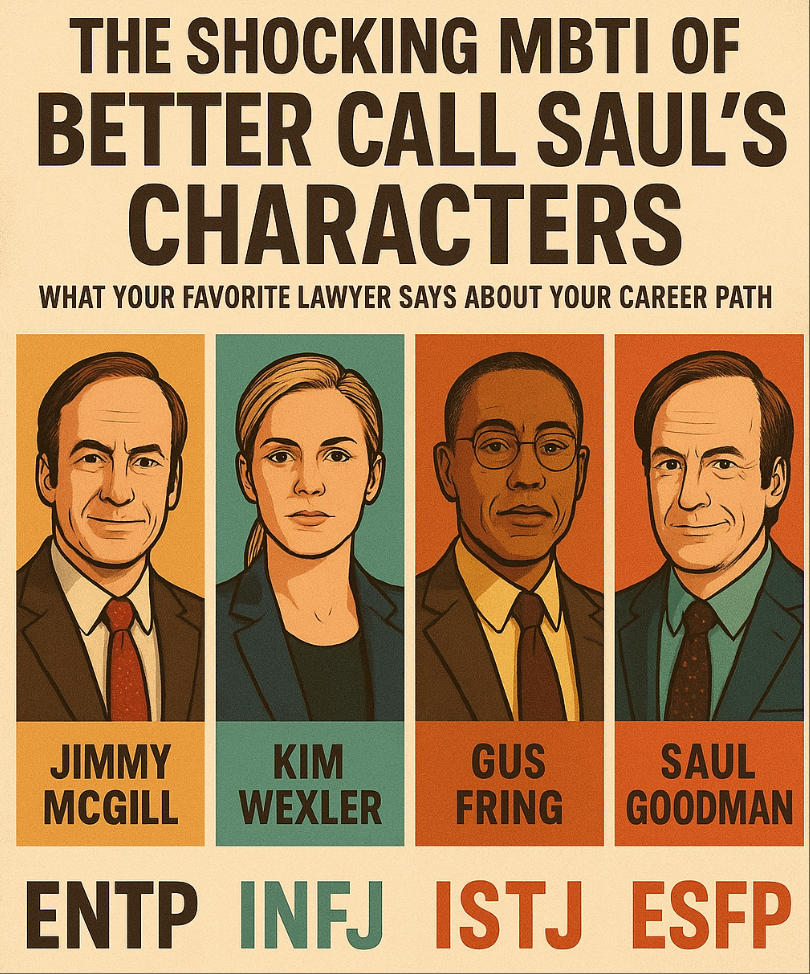
At the heart of the series is the tragic transformation of Jimmy McGill into the flamboyant criminal lawyer Saul Goodman. Jimmy is a quintessential ENTP (The Debater). This personality type is characterized by quick wit, immense creativity, and a talent for seeing unorthodox solutions. ENTPs are charismatic innovators who thrive on challenging the status quo. We see this in Jimmy’s “colorful” marketing tactics and his ingenious, if morally flexible, legal maneuvers. His fundamental need is not for wealth, but to prove his cleverness and win against a system he views as rigged by the “suit-and-tie” establishment embodied by his brother, Chuck.
However, the dark side of the ENTP emerges when their desire to debate and outsmart becomes detached from a strong ethical framework. Jimmy’s con-artist past isn’t just a history; it’s a core part of his personality that he fails to integrate healthily. Instead of using his formidable powers of persuasion for genuine innovation, he channels them into increasingly dangerous and deceptive schemes. His career decline is a cautionary tale for ENTPs: unchecked ingenuity and a compulsion to cut corners can lead to spectacular self-sabotage, undermining even the most brilliant potential.
In stark contrast stands Kim Wexler, one of television’s most compelling portraits of an INTJ (The Architect). INTJs are strategic, independent, and fiercely determined, with a powerful internal moral and logical framework. Kim is the epitome of competence and self-discipline, meticulously building her career from nothing through sheer force of will. She is drawn to the structured, complex world of banking law, which satisfies the INTJ’s love for creating order and executing long-term plans.
Yet, Kim’s relationship with Jimmy reveals a fascinating internal conflict. Her logical INTJ mind knows his schemes are perilous, but her auxiliary Introverted Feeling (Fi) becomes intoxicated by the thrill and the emotional connection they share. Her eventual ethical collapse is not one of a weak character, but of a supremely disciplined one choosing to actively override her own judgment. For INTJs in the workplace, Kim’s arc is a powerful lesson on the danger of allowing a personal relationship or a thirst for excitement to compromise one’s deeply held principles and meticulously crafted career trajectory.
The world of Better Call Saul is anchored by Mike Ehrmantraut, a textbook ISTP (The Virtuoso). ISTPs are pragmatic, observant, and unmatched masters of their immediate environment. They are calm under pressure, excel in hands-on problem-solving, and operate on a straightforward code of cause and effect. Mike’s career evolution from a corrupt cop to a meticulous fixer and enforcer is a logical progression for an ISTP. He isn’t driven by a desire for power like Gus Fring or by a need to prove himself like Jimmy; he is driven by a need to do a job well using his unique skill set.
Mike represents the ISTP who finds a career that perfectly aligns with their talents but in a morally bankrupt industry. His precision, loyalty, and cool-headedness make him exceptionally good at his job, but the work itself is corrosive. His story serves as a critical reminder for ISTPs and similar types: technical excellence and efficiency are invaluable traits, but they must be applied within a field that aligns with your core values. Being the best at what you do means little if the “what” forces you to compartmentalize your humanity.
Finally, the enigmatic Gus Fring (INTJ) acts as a dark mirror to Kim. Both are strategic masterminds, but where Kim’s INTJ traits are ultimately corrupted by emotion, Gus’s are purified into a cold, ruthless calculus. His entire operation is a testament to long-term planning and meticulous control. He exemplifies how the same personality type can achieve monumental success, but the nature of that success—and its soul-destroying cost—is determined by the individual’s core values and choices.
The genius of Better Call Saul is its unflinching examination of how personality is not destiny. Your MBTI type gives you a set of innate strengths and potential weaknesses. Jimmy’s ENTP charisma could have made him a brilliant legal reformer or advertiser. Kim’s INTJ strategic mind was perfectly suited for a high-powered legitimate legal career. Mike’s ISTP competence could have excelled in private security or logistics.
Their downfalls were not preordained by their personality types, but were the result of consistent choices that allowed their shadow traits to dominate. For professionals navigating their own careers, the lesson is clear: understand your innate strengths, be acutely aware of your potential blind spots and temptations, and consciously choose a path that not only utilizes your talents but also nourishes your integrity. Your personality is your engine, but you are still the one who chooses the road.
More TV Character Personality Analysis
- 📊 Take the Free Personality Test — Which TV character shares your type? →
- 🎭 Character Database — 777+ character analyses across movies, TV, and history →
- 📺 Top 20 Famous INTJ Characters — More pop culture personality breakdowns →
- 🧠 MBTI Cognitive Functions — How character personalities are built →
- 🔬 The Analyst Personality Types — NT temperament deep dive →