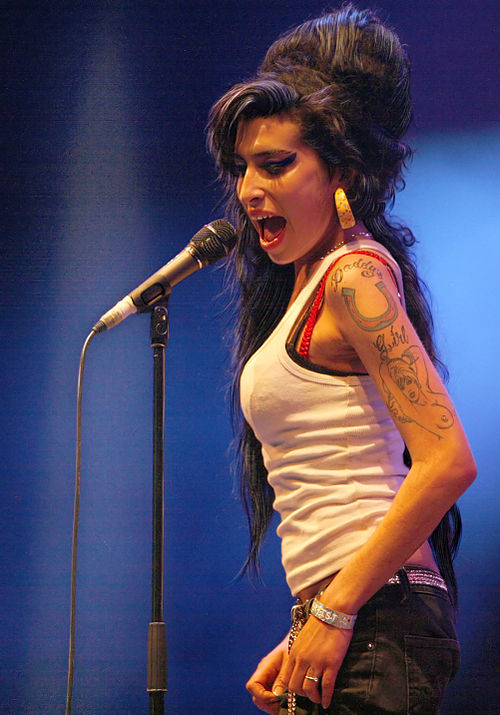
Amy Winehouse strongly exemplifies the ISFP (Introverted Feeling with Extraverted Sensing) personality type. Her dominant Introverted Feeling (Fi) drove her entire artistic identity; her songwriting was a raw, uncompromising excavation of her deepest emotions, values, and personal pain. She had a powerful internal moral and aesthetic compass, fiercely rejecting industry pressures to conform to commercial pop standards (‘I don’t care if I’m not commercial,’ she stated), which fueled her unique retro-soul sound and iconic, defiant personal style. Her decisions were based on personal authenticity rather than external logic or societal norms, making her seem stubborn and resistant to help she perceived as controlling.
Her auxiliary Extraverted Sensing (Se) manifested in her immersive, in-the-moment approach to life and performance. On stage, she was a captivating, physical performer, channeling emotion through her body and voice. Off stage, Se fueled a hedonistic pursuit of intense sensory experiences—through music, fashion, drugs, and alcohol—as a way to cope with and express her turbulent inner world. This Se-Fi loop often led to impulsive actions and a focus on immediate gratification, overshadowing long-term consequences.
Her tertiary Introverted Intuition (Ni) provided flashes of deep insight and symbolic focus, evident in the poignant, often prophetic foreshadowing within her lyrics (e.g., ‘They tried to make me go to rehab, I said no, no, no’). However, under stress, she would neglect this function, becoming trapped in the immediate sensory and emotional overwhelm. Her inferior Extraverted Thinking (Te) represented a major growth challenge and source of stress. She struggled with external structure, organization, and practical life management, often appearing chaotic and resistant to the systematic planning required for her health and career stability. Attempts by others to impose order (management, rehab) were often met with defiance, as they clashed with her dominant Fi’s need for autonomy.