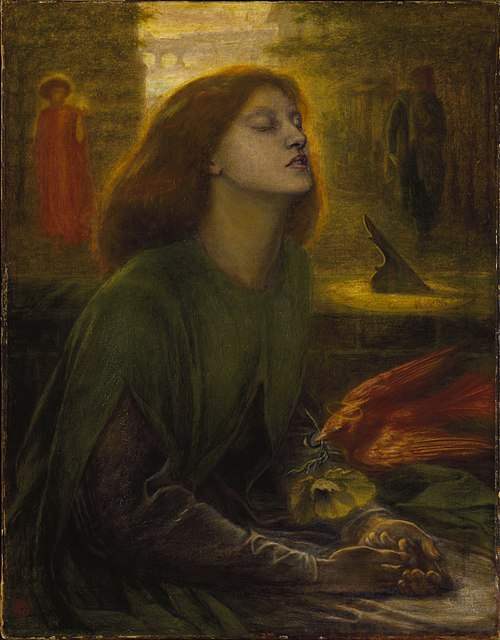
Beatrice is a quintessential INFJ, driven by a dominant Introverted Intuition (Ni) that allows her to perceive profound spiritual truths and ultimate purposes. Her entire literary existence is structured around a symbolic, future-oriented vision: Dante’s salvation and the reader’s edification. She operates not as a mere human character but as a personified ideal, a pattern of divine love made manifest. This Ni vision is supported by auxiliary Extraverted Feeling (Fe), which compels her to guide and uplift others according to a universal, harmonious moral order. Her interactions with Dante are infused with a compassionate but firm desire for his moral improvement and the greater good of his soul.
Her decision-making is principled and theological, reflecting the INFJ’s Ti (Introverted Thinking) in service of her Fe-driven mission. She provides logical, structured theological explanations in Paradise, but this logic always serves her higher ethical and spiritual vision. Her inferior Extraverted Sensing (Se) is evident in her idealized, almost ethereal physical presentation—she is described in radiant, beautiful sensory detail, but this serves her symbolic Ni function rather than representing a grounded engagement with the physical world. Her persona lacks the impulsive or reactive qualities associated with developed Se.
Interpersonally, Beatrice is profoundly impactful yet distant. She is the ultimate ‘catalyst for change,’ entering Dante’s life (and the narrative) at key moments to redirect his path toward the divine. Her relationships are defined by purpose and transformation rather than casual reciprocity. As a Type 1w2, her core drive is toward perfection, integrity, and reform (1), softened by a wing Two’s desire to be loving and helpful in her guidance. She is a reformer who acts out of benevolent, instructive love, scolding Dante for his moral failings only to lead him to a higher state of grace.