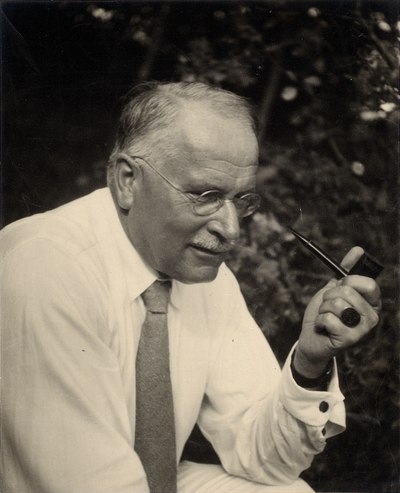
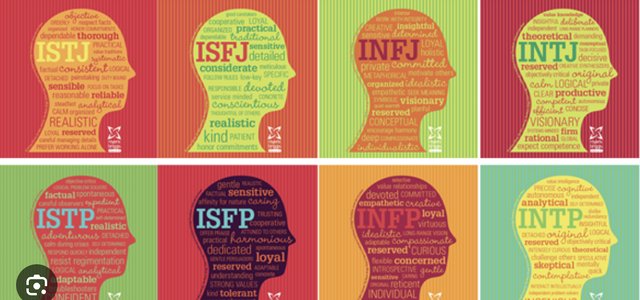
Carl Jung is a quintessential INTJ, driven by a dominant Introverted Intuition (Ni). His life’s work was the exploration of the deep, symbolic patterns underlying human consciousness. Ni allowed him to synthesize vast amounts of data—from clinical cases, mythology, alchemy, and dreams—into grand, unifying theories like the collective unconscious and archetypes. He was not interested in surface-level symptoms but in the underlying, timeless structures of the psyche, a hallmark of Ni’s forward-looking, pattern-seeking nature. His work was the product of deep, solitary reflection, often emerging from his own profound inner experiences and visions.
His auxiliary function, Extraverted Thinking (Te), provided the framework and discipline needed to structure his visionary insights. Jung was a prolific writer and systematizer, meticulously cataloging archetypes and detailing the dynamics of the psyche. Te gave his work its logical rigor and persuasive power, allowing him to present complex psychological concepts in a structured, albeit dense, manner. However, his Te was in service to his Ni vision, not the other way around; he built systems to explain his intuitions, rather than deriving his intuitions purely from empirical data.
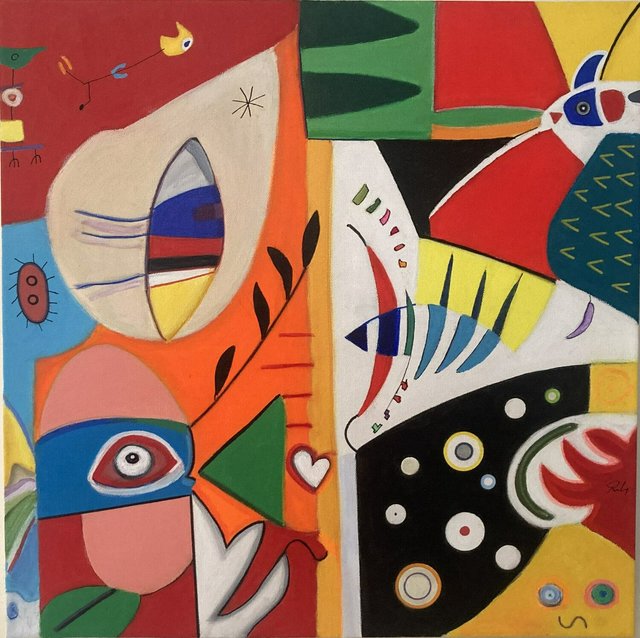
Jung’s tertiary Introverted Feeling (Fi) and inferior Extraverted Sensing (Se) are also evident. His Fi contributed to his strong personal values and his focus on the individual’s journey toward wholeness (indulgence). He broke from Freud not just on intellectual grounds, but because Freud’s reductive, sexual theory violated Jung’s deeper sense of meaning and spirituality. His inferior Se manifested in periods of intense engagement with the physical and artistic world—his stone carving, his tower at Bollingen, his fascination with mandalas and concrete symbols—as a necessary counterbalance to his dominant internal focus. These activities served as a grounding mechanism for his otherwise overwhelmingly abstract mind.
His growth as an individual involved confronting the contents of his inferior function. His mid-life crisis and deliberate exploration of his own unconscious through what became ‘The Red Book’ was a heroic engagement with the chaotic, sensory, and irrational aspects (Se) that his dominant Ni typically suppressed. This process of integrating the shadow and the anima/animus is the practical application of his own theory of individuation, demonstrating a lifelong commitment to psychological growth that moved beyond mere intellectual theorizing.