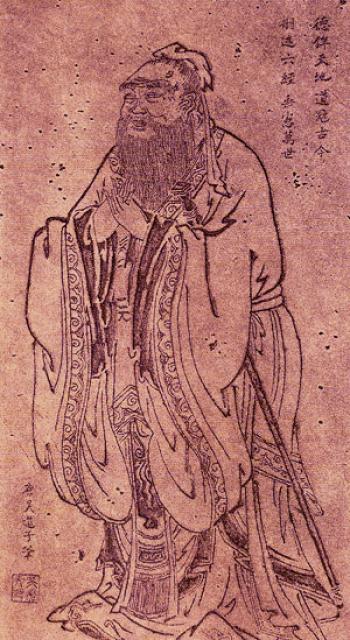
Confucius exemplifies the INFJ personality type, driven by a dominant Introverted Intuition (Ni). This function allowed him to perceive deep, underlying patterns in human society and history, synthesizing them into a coherent, visionary system of ethics and governance aimed at creating a harmonious world. His life’s work was not about inventing new ideas but about discerning the timeless ‘Way’ (Dao) from the wisdom of ancient sages, a classic Ni pursuit of unifying principles and future-oriented ideals.
His auxiliary function, Extraverted Feeling (Fe), is evident in his profound focus on social harmony, propriety (Li), and human-heartedness (Ren). Confucius was deeply concerned with the collective well-being and the proper conduct of relationships within the family and state. His teachings are fundamentally relational and community-oriented, emphasizing empathy, respect for elders, and benevolent leadership. The Fe function sought to externalize his Ni vision through a structured system of social ethics that would create a stable and moral society.
The tertiary function, Introverted Thinking (Ti), provided the logical structure to his philosophical system. He engaged in precise definitions (e.g., of Ren, Li, Xiao) and used careful reasoning to connect his ethical principles. His method of teaching involved questioning and dialogue aimed at leading students to discover truth through their own reasoning, a sign of developed Ti. The inferior Extraverted Sensing (Se) manifests in his occasional frustrations with the chaotic reality of his time—the ‘Spring and Autumn Period’ of warfare and disorder—and his practical, though ultimately unsuccessful, attempts to advise rulers and implement his ideas in real-world politics. His emphasis on ritual and aesthetic form in music and ceremony also shows an engagement with the sensory world in service of his higher ideals.