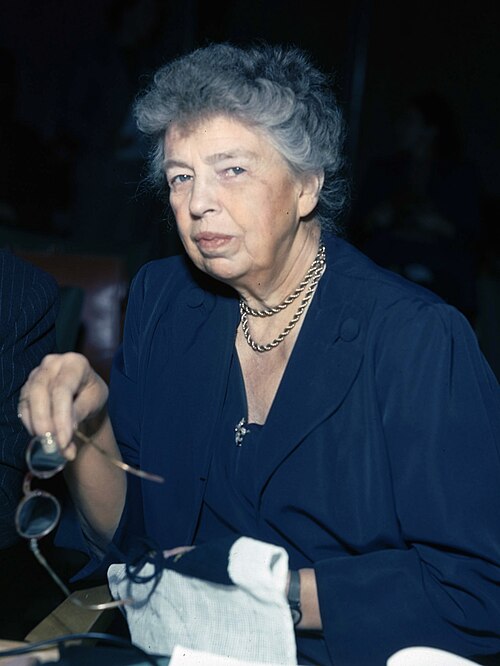
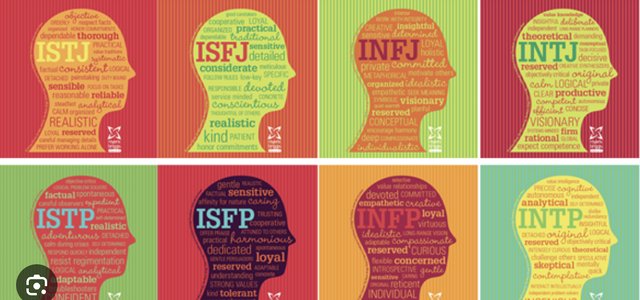
Eleanor Roosevelt exemplifies the ENFJ (The Protagonist) personality type, driven by Extraverted Feeling (Fe) as her dominant function. Her life’s work was centered on harmony, humanitarian values, and the betterment of society. She possessed a profound empathy for the disadvantaged and an uncanny ability to connect with people from all walks of life, using her platform to give voice to the voiceless. Her decision-making was consistently guided by her ethical principles and a vision for a more just world, rather than personal gain or cold logic.
Her auxiliary function, Introverted Intuition (Ni), provided her with a forward-looking, visionary perspective. She could synthesize complex social issues into a coherent moral framework and anticipate future needs, such as her early advocacy for civil rights and her pivotal role in crafting the Universal Declaration of Human Rights. This Ni-Fe combination made her a powerful and persuasive advocate, able to articulate an inspiring ideal and mobilize people toward it. Her tertiary Extraverted Sensing (Se) was evident in her hands-on, energetic approach; she traveled extensively, visited coal mines and slums, and wrote a prolific newspaper column, staying directly engaged with the tangible realities of the world she sought to change.
As with many ENFJs, her inferior function, Introverted Thinking (Ti), could present growth areas. While fiercely intelligent, she sometimes prioritized consensus and moral imperative over rigorous, detached analysis of systems, which could lead to political naivete or frustration with bureaucratic details. Her personal growth involved channeling her deep convictions into structured, lasting institutions like the UN. The Enneagram 1w2 (The Advocate) further refines this profile, combining the One’s core drive for integrity and reform with the Two wing’s nurturing, relational approach to achieving it.