Hester Prynne - ISFP Personality Type

Hester Prynne

ISFP - Adventurer

Category

Literature

Nationality

English

Occupation

Seamstress / Embroiderer

About Hester Prynne

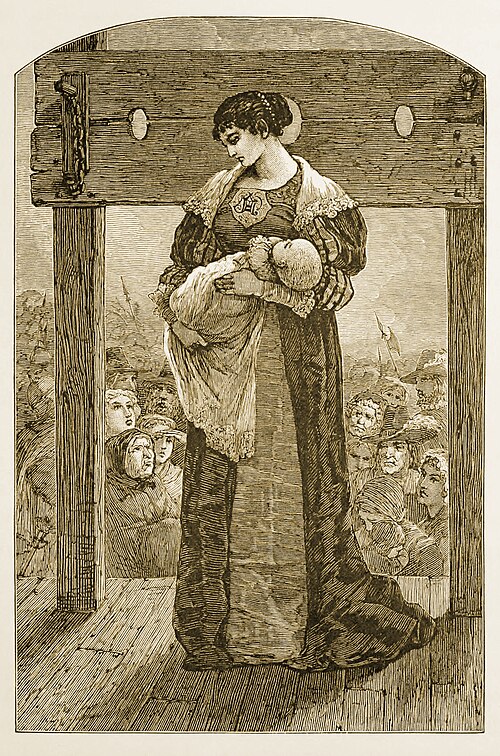
Hester Prynne is the protagonist of Nathaniel Hawthorne's 1850 novel 'The Scarlet Letter'. She is an Englishwoman living in 17th-century Puritan Boston who is publicly shamed and forced to wear a scarlet 'A' for adultery after bearing a daughter out of wedlock. She is known for her quiet strength, resilience, and defiance of the oppressive social and religious norms of her community.

Personality Profile: ISFP

Confidence: 85%

Personality Analysis

Hester Prynne is a quintessential ISFP. Her dominant Introverted Feeling (Fi) is the core of her identity. She maintains a strong, internal, and deeply personal moral compass that stands in stark contrast to the external, communal morality of the Puritan theocracy. She judges herself by her own standards of love, truth, and maternal devotion, not by the letter of the law or public scorn. This is why she never publicly names her lover, Dimmesdale, and why she ultimately chooses to remain in Boston, transforming the symbol of her shame into a badge of her own unique identity and quiet strength.

Her auxiliary Extraverted Sensing (Se) is evident in her practical resilience and her tangible, sensory-focused life. She supports herself and Pearl through her exquisite skill with a needle (Se), a talent that makes the scarlet letter itself a work of art. She is grounded in the present reality of her situation—raising her daughter, living in the cottage, dealing with the daily reality of her ostracism—without becoming lost in abstract what-ifs. Her tertiary Intuition (Ni) provides her with a growing, long-term insight into the hypocrisy of her society and the deeper meaning of her experience, which she expresses in her later counsel to other troubled women.

Her inferior Extraverted Thinking (Te) is seen in her initial powerlessness within the rigid, logical structure of Puritan law and governance. Over time, she develops a measure of this function, becoming a quiet counselor and a stabilizing force in the community, using her hard-won wisdom to guide others. Her primary growth area involves moving from purely internal, value-based endurance to actively using her influence to shape her external world, however modestly. Her personality is defined by a profound harmony-seeking (Enneagram 9) guided by a principled inner critic (wing 1), leading to a life of peaceful, yet unwavering, non-conformity.

Supporting Evidence

Her refusal to name Dimmesdale, despite immense pressure, demonstrates her dominant Fi, protecting her internal truth and his autonomy. Her choice to stay in Boston and wear the ‘A’ willingly after the opportunity to leave arises from her Fi-Ni conviction to see her personal story through on her own terms. Her meticulous, beautiful embroidery work, which becomes both her livelihood and a subtle act of defiance (embellishing the symbol meant to shame her), showcases her auxiliary Se. Her transformation in the community’s eyes from a sinner to a wise ‘Sister of Mercy’ to whom other women confide their sorrows shows the development of her inferior Te, as she begins to use her experience to counsel others systematically.

Cognitive Function Stack

Confidence: 85%

The cognitive function stack represents how an individual processes information and makes decisions based on Jungian personality type theory.

Auxiliary Function: Se

Extraverted Sensing - Experiencing and interacting with the immediate environment.

Dominant Function: Fi

Introverted Feeling - Making decisions based on internal values and personal ethics.

Inferior Function: Te

Extraverted Thinking - Organizing and structuring the external world logically and efficiently.

Tertiary Function: Ni

Introverted Intuition - Perceiving underlying patterns and developing long-range visions.

Enneagram Personality Profile:

Confidence: 85%

9w1

Big Five Personality Traits

Confidence: 85%

The Big Five personality traits represent the five broad dimensions of personality that are commonly used to describe human personality.

Openness 0%
Conscientiousness 0%
Extraversion 0%
Agreeableness 0%
Neuroticism 0%

Similar ISFP Characters

Explore other characters with similar personality traits