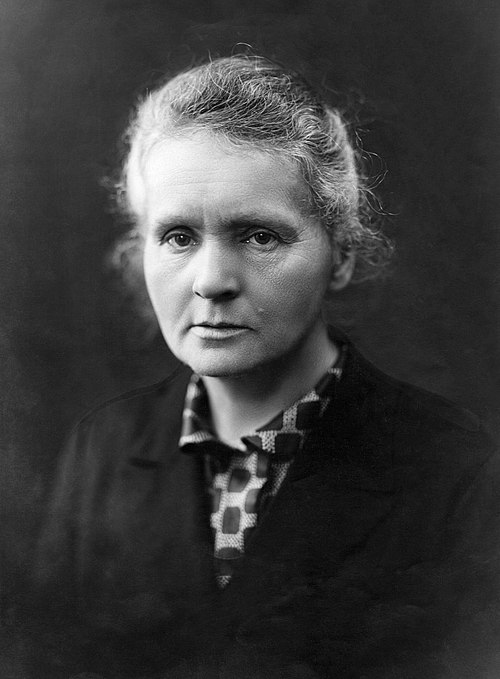
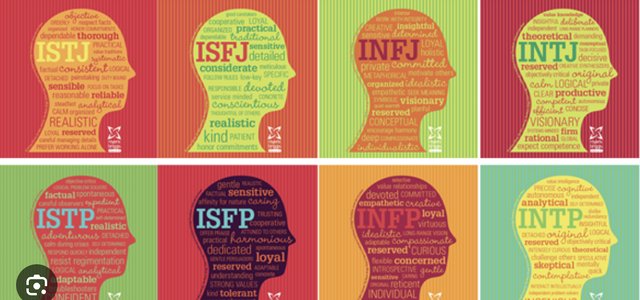
Marie Curie exemplifies the INTJ personality type through her dominant Introverted Intuition (Ni), which allowed her to form a singular, visionary understanding of the unseen forces within matter. She was driven by a deep, internal vision of scientific truth, pursuing a line of inquiry (radioactivity) that was entirely novel and not yet understood by the scientific establishment. This future-oriented, pattern-seeking function is classic Ni, guiding her toward paradigm-shifting discoveries. Her auxiliary function, Extraverted Thinking (Te), provided the rigorous, logical framework to execute her vision. She approached her work with extreme methodological precision, systematically processing tons of uranium ore to isolate minute amounts of new elements. This Te drive for efficiency, order, and empirical proof was the engine of her laboratory work. Interpersonally, she was reserved, private, and intensely focused, typical of an INTJ. She formed a profound intellectual partnership with her husband, Pierre, which was more a meeting of minds than an emotionally expressive union, and she largely ignored public opinion and societal constraints on women. Her tertiary Introverted Feeling (Fi) manifested in her strong personal ethics, her dedication to science for its own sake and for human benefit, and her quiet patriotism for her native Poland (naming polonium after it). Her inferior Extraverted Sensing (Se) showed in her occasional neglect of physical well-being and safety, working with hazardous materials without protection, and her ability to endure extreme physical discomfort in her laboratory conditions, which she saw as irrelevant to her intellectual mission.