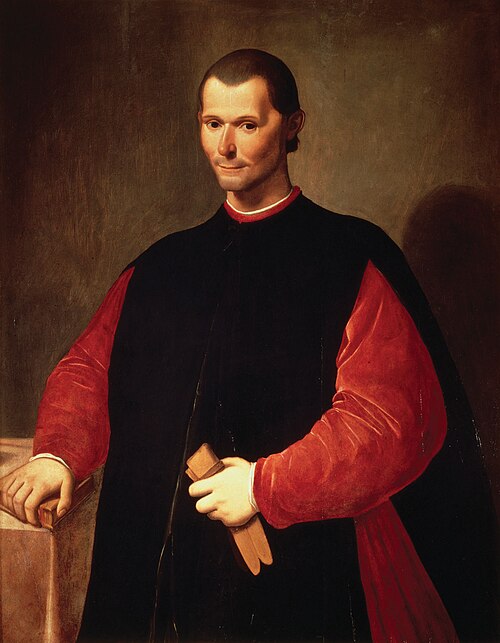
Niccolò di Bernardo dei Machiavelli - INTJ Personality Type

Niccolò di Bernardo dei Machiavelli

INTJ - Architect

Category

History

Nationality

Florentine (Italian)

Occupation

Diplomat, Political Philosopher, Writer

About Niccolò di Bernardo dei Machiavelli

Niccolò Machiavelli was a Renaissance-era Florentine diplomat, philosopher, and writer, often called the father of modern political science. He is most famous for his seminal political treatise, 'The Prince,' which advocated for pragmatic, results-oriented statecraft, separating political morality from personal ethics. His name became synonymous with cunning, ruthless political strategy, giving rise to the term 'Machiavellian.'

Personality Profile: INTJ

Confidence: 85%

Personality Analysis

Machiavelli exhibits a strong INTJ cognitive function stack. His dominant Introverted Intuition (Ni) is evident in his ability to synthesize vast historical and contemporary political observations into a singular, coherent vision of effective statecraft. He looked beyond superficial morality to discern the underlying, timeless principles of power dynamics and human nature. This future-oriented, strategic foresight aimed to provide a unified Italy, a grand vision he pursued with single-minded focus. His auxiliary Extraverted Thinking (Te) drove him to organize these insights into the systematic, logical, and ruthlessly pragmatic advice found in ‘The Prince’ and ‘The Discourses.’ He valued effectiveness, efficiency, and results above all, famously arguing that the ends justify the means for a ruler seeking to maintain the state. This Te preference for objective systems over subjective feelings led to his reputation for cold rationality. His tertiary Introverted Feeling (Fi) manifests not as sentimentality, but as a deep, internal conviction in his own ideals—specifically, a passionate, private love for a strong, republican Florence and Italy. This inner value system fueled his work, even as his Te analysis led him to advise actions that contradicted conventional morality. His inferior Extraverted Sensing (Se) appears in his occasional lapses into vivid, almost brutal, sensory imagery (e.g., describing fortuna as a raging river) and, during his exile, in his documented enjoyment of rustic life and storytelling, which served as an escape from his primary intellectual pursuits.

Supporting Evidence

His masterpiece, ‘The Prince,’ is a quintessential INTJ document: it uses historical examples (Ni pattern recognition) to build a logical, systematic manual for acquiring and maintaining power (Te). His extensive dispatches as a diplomat show meticulous observation and analysis of leaders and events, reducing complex political landscapes to strategic assessments. His personal letters, particularly those describing his life in exile, reveal his retreat into intellectual study and writing (classic INTJ/5w6 behavior) after being removed from active political life, channeling his frustration into theoretical work. His famous advice that ‘it is better to be feared than loved’ exemplifies Te-Fi in tension, prioritizing a calculated, effective outcome (Te) over the emotional bonds (Fe) typically valued in leadership, guided by an internal logic of state survival (Fi).

Cognitive Function Stack

Confidence: 85%

The cognitive function stack represents how an individual processes information and makes decisions based on Jungian personality type theory.

Auxiliary Function: Te

Extraverted Thinking - Organizing and structuring the external world logically and efficiently.

Dominant Function: Ni

Introverted Intuition - Perceiving underlying patterns and developing long-range visions.

Inferior Function: Se

Extraverted Sensing - Experiencing and interacting with the immediate environment.

Tertiary Function: Fi

Introverted Feeling - Making decisions based on internal values and personal ethics.

Enneagram Personality Profile:

Confidence: 85%

5w6

Big Five Personality Traits

Confidence: 85%

The Big Five personality traits represent the five broad dimensions of personality that are commonly used to describe human personality.

Openness 0%
Conscientiousness 0%
Extraversion 0%
Agreeableness 0%
Neuroticism 0%

Similar INTJ Characters

Explore other characters with similar personality traits