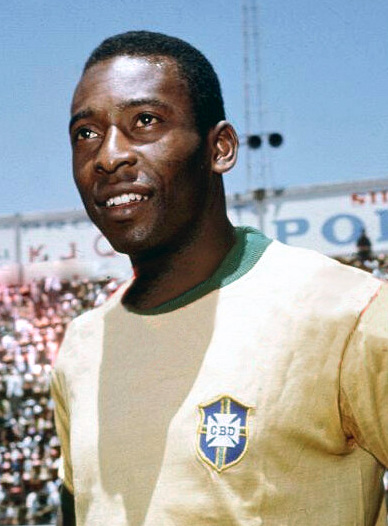
Pelé exemplifies the ESFP personality type, primarily driven by Extraverted Sensing (Se). His genius was rooted in an unparalleled, real-time awareness of the physical environment on the pitch. He processed the positions of players, the ball’s movement, and spatial opportunities with instantaneous, fluid brilliance, making him a master of improvisation and dazzling, spontaneous plays. This dominant Se was perfectly suited to the dynamic, fast-paced world of elite sports, where he was fully immersed in the sensory excitement of the game.
His auxiliary Introverted Feeling (Fi) provided the internal compass guiding his actions. His famous nickname, ‘Pelé,’ was initially a source of childhood distress, but he embraced it, showing a personal connection to his identity. His loyalty to Brazil and Santos, his joyful, expressive goal celebrations, and his genuine, heartfelt connections with fans all point to a deep-seated personal value system. He was not just performing; he was expressing a profound personal love for the game and his people. His humanitarian work, such as serving as a UNESCO Goodwill Ambassador, stemmed from this authentic inner concern.
The tertiary function, Extraverted Thinking (Te), emerged in his practical and goal-oriented approach off the field. He was a shrewd businessman and marketer who leveraged his fame, becoming one of the first global sports brands. He also served as Brazil’s Extraordinary Minister for Sport, applying a pragmatic approach to legislation. His inferior Introverted Intuition (Ni) was his growth area—while his on-field vision was Se-based tactical genius, long-term strategic life planning was less natural. His post-retirement ventures sometimes lacked cohesive long-term vision, and he occasionally faced criticism for being overly optimistic or avoiding complex, abstract future planning, preferring to engage with the tangible present.