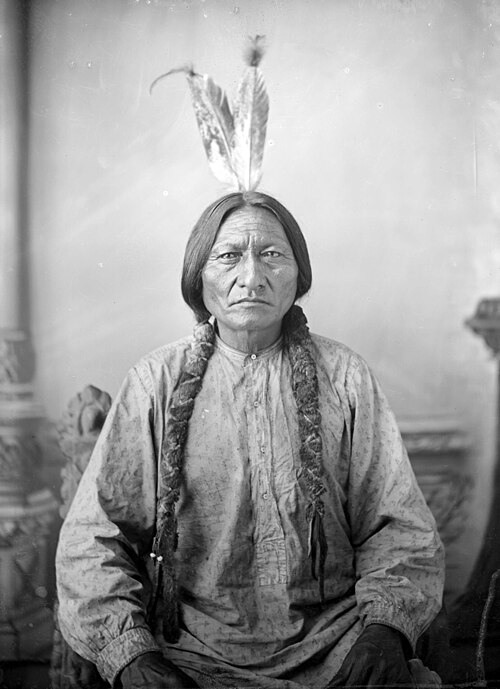
Sitting Bull (Tȟatȟáŋka Íyotake) - INFJ Personality Type

Sitting Bull (Tȟatȟáŋka Íyotake)

INFJ - Advocate

Category

History

Nationality

Hunkpapa Lakota (Indigenous American)

Occupation

Tribal Chief, Holy Man (Wičháša Wakȟáŋ)

About Sitting Bull (Tȟatȟáŋka Íyotake)

Sitting Bull was a Hunkpapa Lakota holy man and war chief who led his people during a period of fierce resistance against United States government policies. He is most famous for his role in the defeat of Lieutenant Colonel George Custer at the Battle of the Little Bighorn in 1876. His profound spiritual leadership and unwavering commitment to preserving Lakota land and culture made him an enduring symbol of Native American resistance and sovereignty.

Personality Profile: INFJ

Confidence: 85%

Personality Analysis

Sitting Bull’s personality aligns strongly with the INFJ type. His dominant Introverted Intuition (Ni) was expressed through his powerful, prophetic visions that provided guidance for his people, most famously his vision of U.S. soldiers falling into the Lakota camp like grasshoppers, which foreshadowed the victory at Little Bighorn. He was not a detail-oriented tactician but a strategic visionary who understood the broader, existential struggle for his people’s survival and way of life. His decision-making was deeply rooted in this long-term, symbolic perspective, seeking to uphold the spiritual and cultural integrity of the Lakota against overwhelming odds. His auxiliary Extraverted Feeling (Fe) manifested in his role as a unifying leader and protector. He was deeply connected to the well-being and harmony of his community, earning immense respect and loyalty. He used his influence to forge a broad alliance of tribes, demonstrating a focus on collective good. His tertiary Introverted Thinking (Ti) supported his strategic reasoning, allowing him to analyze threats and devise plans that were pragmatic within his spiritual framework. His inferior Extraverted Sensing (Se) appeared in moments of intense, present-moment action—such as his famous courage under fire—and in his appreciation for the tangible world of nature and ceremony, though he primarily lived in the world of ideas and the future. As a 1w9 Enneagram, his core drive was a righteous, principled stand (Type 1) against injustice, tempered by a desire for peace and internal stability (wing 9), unless forced into conflict.

Supporting Evidence

His prophetic vision before the Battle of the Little Bighorn is a quintessential example of dominant Ni, providing a symbolic and strategic guide for his people. His leadership was not based on seeking personal power but on a profound sense of responsibility (Fe) for his community’s welfare, as seen in his role as a unifying figure among diverse tribes. His famous refusal to sign the 1868 Fort Laramie Treaty, understanding it would ultimately undermine Lakota sovereignty, demonstrates his long-term, principled (Ti/Type 1) strategic thinking. His composed and courageous demeanor during the Sun Dance ceremony, where he sacrificed 100 pieces of flesh from his arms, shows his ability to harness inferior Se in service of his spiritual convictions (Ni). Even in his final years, his steadfast refusal to abandon his people’s traditions or submit to U.S. authority, culminating in his killing during a botched arrest, underscores his unwavering commitment to his visionary principles.

Cognitive Function Stack

Confidence: 85%

The cognitive function stack represents how an individual processes information and makes decisions based on Jungian personality type theory.

Auxiliary Function: Fe

Extraverted Feeling - Connecting with others and maintaining social harmony.

Dominant Function: Ni

Introverted Intuition - Perceiving underlying patterns and developing long-range visions.

Inferior Function: Se

Extraverted Sensing - Experiencing and interacting with the immediate environment.

Tertiary Function: Ti

Introverted Thinking - Analyzing and categorizing information logically and precisely.

Enneagram Personality Profile:

Confidence: 85%

1w9

Big Five Personality Traits

Confidence: 85%

The Big Five personality traits represent the five broad dimensions of personality that are commonly used to describe human personality.

Openness 0%
Conscientiousness 0%
Extraversion 0%
Agreeableness 0%
Neuroticism 0%

Similar INFJ Characters

Explore other characters with similar personality traits