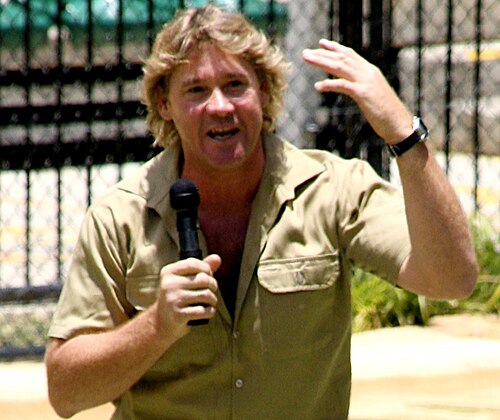
Steve Irwin is a quintessential ESFP, with Extraverted Sensing (Se) as his dominant function. This is evident in his total immersion in the present moment, his acute awareness of his physical environment, and his thrill-seeking, hands-on interaction with wildlife. He processed the world through direct sensory experience, reacting with lightning-fast reflexes to the animals he handled. His decision-making was guided by his auxiliary Introverted Feeling (Fi), which provided a strong internal compass of passion, care, and personal ethics. His conservation work wasn’t driven by complex ideological frameworks but by a deep, heartfelt love for animals and a simple, powerful value: ‘Crikey, we’ve got to save this beauty!’
His tertiary Extraverted Thinking (Te) emerged in his pragmatic, can-do approach to running Australia Zoo and his effective, action-oriented conservation projects. He was a natural showman and educator, using Te to organize information and demonstrate facts in an engaging, straightforward manner. His inferior Introverted Intuition (Ni) was the area of least comfort; he was not one for long-term strategic planning or abstract future visions. His focus was overwhelmingly on the tangible, immediate present—the animal in front of him, the camera rolling, and the audience he was thrilling right now.
Interpersonally, Irwin’s ESFP nature made him incredibly charismatic and relatable. He connected with people through shared experience and emotion, not intellectual debate. His growth as a public figure involved channeling his raw Se/Fi energy into a coherent Te-driven message of conservation, becoming a global ambassador for his cause. A potential growth area for an ESFP is developing Ni—considering long-term consequences and broader systemic strategies—which, while present in his legacy, was not his primary mode of operation.