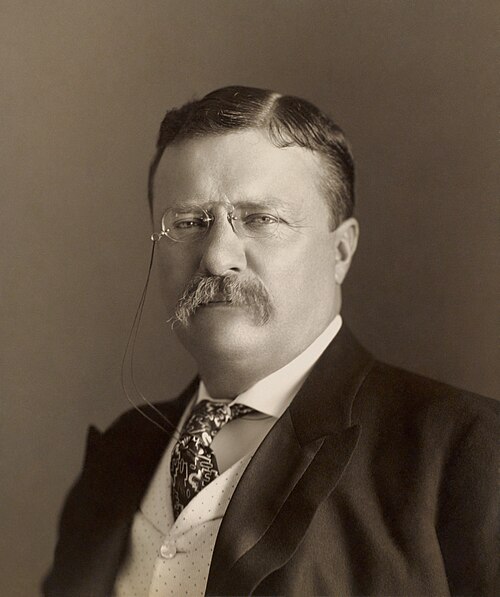
Theodore Roosevelt is a quintessential ESTP, driven by Extraverted Sensing (Se) as his dominant function. He lived fully in the present, seeking intense sensory experiences and immediate action, whether leading the Rough Riders up San Juan Hill, exploring the Amazon, or embarking on vigorous hikes. His decision-making was guided by a sharp, internal logic (auxiliary Introverted Thinking - Ti), allowing him to analyze situations pragmatically and devise effective, often unorthodox, solutions, such as his use of antitrust laws or his role in mediating the Russo-Japanese War. His tertiary Extraverted Feeling (Fe) manifested in a charismatic, populist style that connected him deeply with the public (‘the bully pulpit’) and a strong sense of fairness, though it could be overridden by his forceful will. His inferior Introverted Intuition (Ni) appeared as a distrust of abstract, long-term ideology not grounded in experience, though in maturity he developed a forward-looking vision for conservation and national greatness. Roosevelt’s interpersonal dynamics were those of a classic 8w7 Enneagram: confrontational, protective, and enthusiastic, with a love of challenge and a tendency to dominate his environment. Growth for an ESTP involves integrating Ni, which Roosevelt did by developing enduring legacies like the national park system, moving beyond mere thrill-seeking to strategic, lasting impact.