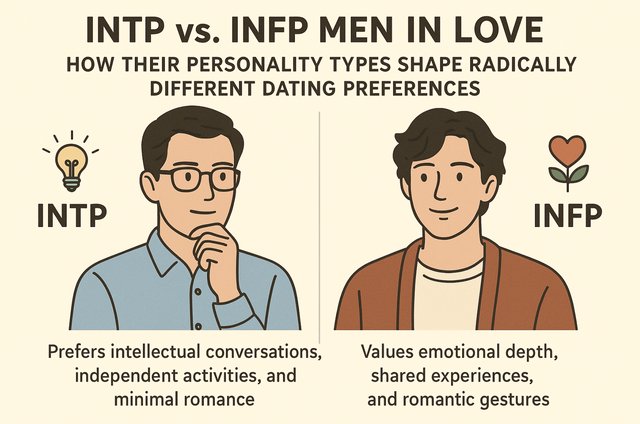
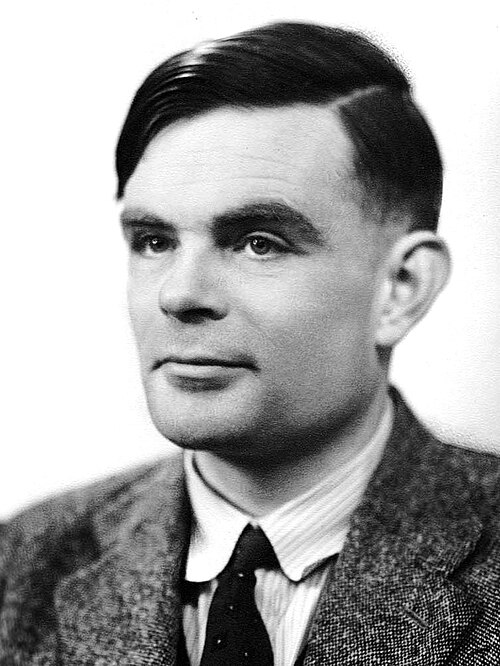
Alan Mathison Turing - INTP Personality Type

Alan Mathison Turing

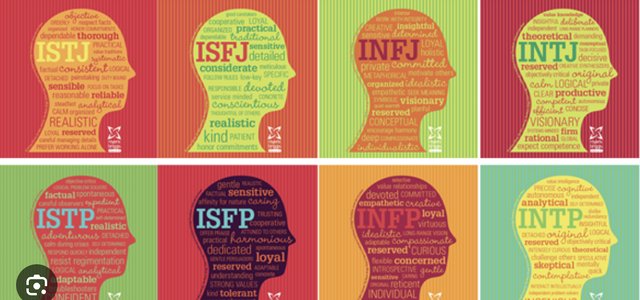
INTP - Logician

Category

Science

Nationality

British

Occupation

Mathematician, Computer Scientist, Cryptanalyst

About Alan Mathison Turing

Alan Turing was a pioneering English mathematician, computer scientist, and cryptanalyst. He is widely considered the father of theoretical computer science and artificial intelligence, and is best known for his crucial role in breaking the German Enigma code during World War II, which significantly shortened the war and saved countless lives.

Personality Profile: INTP

Confidence: 85%

Personality Analysis

Alan Turing exemplifies the INTP personality type, driven by a dominant Introverted Thinking (Ti) function. His entire approach to the world was one of building and refining complex internal models of logic and systems. This is most evident in his conceptualization of the Turing Machine, an abstract model of computation that defined the limits of what could be algorithmically computed. His work was not about applying existing knowledge, but about constructing new, fundamental logical frameworks from the ground up. His decision-making was purely rational, often leading him to conclusions that defied contemporary social or scientific norms, such as his early advocacy for machine intelligence.

His auxiliary Extraverted Intuition (Ne) allowed him to make brilliant, creative leaps by connecting seemingly unrelated ideas. He didn’t just improve code-breaking; he invented entirely new statistical and mechanical approaches, like the Bombe, by synthesizing logic, probability, and engineering. This Ne-Ti combination fueled his boundless curiosity across disciplines—from biology and morphogenesis to computer design. However, his inferior Extraverted Feeling (Fe) manifested as a social awkwardness and a difficulty navigating the emotional and political landscapes of his time. He was famously eccentric, with a blunt, literal communication style that could alienate others, and he was tragically vulnerable to societal persecution due to his inability to conform or manage his public image effectively.

Turing’s tertiary Introverted Sensing (Si) provided a repository of past data and patterns, which he used to inform his models. His meticulous work on cryptanalysis required recalling vast amounts of cipher data and historical patterns. Yet, his growth area lay in integrating his inferior Fe. His life story suggests a man whose profound internal logic (Ti) was ultimately at odds with the illogical prejudices of his society, a conflict his personality was ill-equipped to resolve. An evolved INTP learns to value social harmony and emotional intelligence without compromising their logical integrity, a balance Turing was not afforded the opportunity to fully develop.

Supporting Evidence

His invention of the Turing Machine is a pure expression of dominant Ti, creating an abstract logical model to solve a theoretical problem. His work at Bletchley Park demonstrated auxiliary Ne, as he combined insights from mathematics, logic, and engineering to conceive of the Bombe, a novel electromechanical device for deciphering Enigma. His famous 1950 paper “Computing Machinery and Intelligence,” which proposed the Turing Test, showcases his Ne-driven ability to extrapolate future possibilities from current knowledge. His personal eccentricities, such as chaining his mug to a radiator or running long distances in an gas mask to combat allergies, highlight his disregard for social norms (inferior Fe). Finally, his straightforward, legally perilous admission of his homosexuality to police reflects a Ti-driven commitment to factual truth, utterly devoid of Fe’s strategic concern for social consequences.

Cognitive Function Stack

Confidence: 85%

The cognitive function stack represents how an individual processes information and makes decisions based on Jungian personality type theory.

Auxiliary Function: Ne

Extraverted Intuition - Seeing possibilities and connections in the external world.

Dominant Function: Ti

Introverted Thinking - Analyzing and categorizing information logically and precisely.

Inferior Function: Fe

Extraverted Feeling - Connecting with others and maintaining social harmony.

Tertiary Function: Si

Introverted Sensing - Recalling detailed information and maintaining traditions.

Enneagram Personality Profile:

Confidence: 85%

5w4

Big Five Personality Traits

Confidence: 85%

The Big Five personality traits represent the five broad dimensions of personality that are commonly used to describe human personality.

Openness 0%
Conscientiousness 0%
Extraversion 0%
Agreeableness 0%
Neuroticism 0%