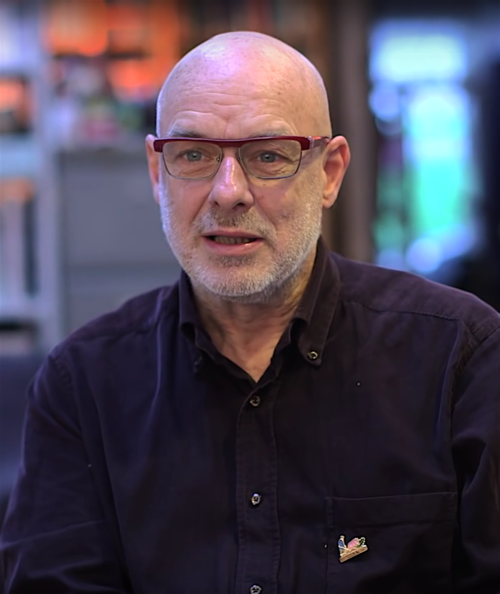
Brian Eno exemplifies the INTP type through his dominant Introverted Thinking (Ti), which drives his need to build and deconstruct complex internal models of how music, art, and systems work. He is less interested in emotional expression for its own sake than in the logical principles underpinning creative acts. This is seen in his creation of ‘Oblique Strategies’ cards—a system to break creative deadlocks through logical but random prompts—and his definition of ambient music as an ‘environment’ with intellectual parameters rather than a traditional narrative. His auxiliary Extroverted Intuition (Ne) fuels his endless experimentation and exploration of possibilities, from tape loops and generative systems to collaborations across diverse artistic fields. This function manifests as a constant state of ‘what if?’, making him a pioneer in multiple domains.
Interpersonally, Eno often takes on the role of a catalyst or conceptual guide (inferior Extroverted Feeling, Fe), preferring to work behind the scenes as a producer who sets conditions for creativity rather than as a frontman. He is described as a brilliant theorist and conversationalist but maintains a certain detached, observational quality, consistent with an INTP’s preference for ideas over emotional entanglement. His tertiary Introverted Sensing (Si) is evident in his ability to curate and reference a vast personal archive of sonic textures and artistic ideas from the past, which he then re-contextualizes through his Ti-Ne framework.
Growth for an INTP often involves integrating the inferior Fe, and Eno has done this productively by focusing on the social and environmental impact of his ideas—exploring how music affects mood and space, and engaging in collaborative projects that require harmonizing diverse personalities. However, his core motivation remains the pleasure of the intellectual puzzle itself. He is not a performer seeking applause but a thinker seeking elegant systems, making the studio his laboratory and the world his test subject.