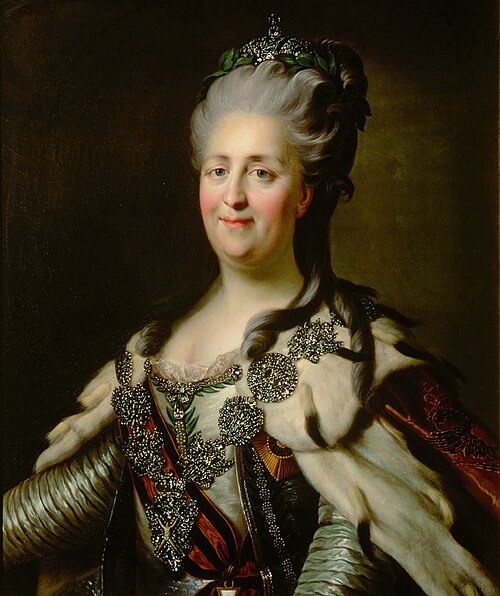
Sophie Friederike Auguste von Anhalt-Zerbst-Dornburg, later Catherine II of Russia - ENTJ Personality Type

Sophie Friederike Auguste von Anhalt-Zerbst-Dornburg, later Catherine II of Russia

ENTJ - Commander

Category

History

Nationality

Prussian-born, Russian ruler

Occupation

Empress Regnant of Russia

About Sophie Friederike Auguste von Anhalt-Zerbst-Dornburg, later Catherine II of Russia

Catherine the Great was the Empress of Russia from 1762 to 1796, following a coup that deposed her husband, Peter III. She is known for modernizing Russia along Western European lines, expanding its territory significantly, and being a patron of the arts, education, and the Enlightenment. Her reign is considered a Golden Age of the Russian Empire.

Personality Profile: ENTJ

Confidence: 85%

Personality Analysis

Catherine the Great exemplifies the ENTJ (The Commander) archetype. Her dominant Extraverted Thinking (Te) is evident in her relentless drive for efficiency, systemic reform, and decisive action. She governed with a pragmatic, goal-oriented focus, restructuring provincial administration, modernizing the economy, and seeking to codify laws. Her decision-making was rational and often impersonal, prioritizing the strength and order of the state above sentiment. Her auxiliary Introverted Intuition (Ni) provided the grand strategic vision. She didn’t just rule; she sought to transform Russia into a great European power and a center of enlightened civilization. This Ni-driven vision fueled her territorial expansions, her ambitious legislative goals like the Nakaz, and her patronage of philosophers and artists. Her tertiary Extraverted Sensing (Se) manifested in her appreciation for the finer, tangible aspects of power and culture—the splendor of her court, magnificent architecture, and her active, often passionate, engagement with life and lovers. It also fueled her boldness in seizing the throne. Her inferior Introverted Feeling (Fi) was her area of least comfort. While she wrote extensively about ideals and sentiment, her actions were often ruthlessly pragmatic. Her personal relationships were frequently instrumental, and her failure to address serfdom meaningfully, despite knowing its injustice, highlights a disconnect between enlightened ideals (Fi values) and realpolitik (Te goals).

Supporting Evidence

Her orchestration of the coup against her husband, Peter III, demonstrates Te-Ni strategic planning and Se boldness. The drafting of the ‘Nakaz,’ or Instruction, a progressive guide for a new law code based on Enlightenment principles, shows her Ni vision for a reformed state, even if its implementation was limited. Her extensive correspondence with Enlightenment figures like Voltaire and Diderot reveals her intellectual engagement and desire to be seen as a ‘philosopher on the throne,’ aligning with Ni/Te. Her handling of the Pugachev Rebellion—crushing it with overwhelming force while subsequently tightening central control over the provinces—exemplifies Te decisiveness and pragmatic consolidation of power over Fi empathy. Finally, her territorial acquisitions, such as the partitions of Poland and victories against the Ottoman Empire, were the ultimate expression of her ENTJ drive to expand and strengthen her empire through calculated strategy.

Cognitive Function Stack

Confidence: 85%

The cognitive function stack represents how an individual processes information and makes decisions based on Jungian personality type theory.

Auxiliary Function: Ni

Introverted Intuition - Perceiving underlying patterns and developing long-range visions.

Dominant Function: Te

Extraverted Thinking - Organizing and structuring the external world logically and efficiently.

Inferior Function: Fi

Introverted Feeling - Making decisions based on internal values and personal ethics.

Tertiary Function: Se

Extraverted Sensing - Experiencing and interacting with the immediate environment.

Enneagram Personality Profile:

Confidence: 85%

8w7

Big Five Personality Traits

Confidence: 85%

The Big Five personality traits represent the five broad dimensions of personality that are commonly used to describe human personality.

Openness 0%
Conscientiousness 0%
Extraversion 0%
Agreeableness 0%
Neuroticism 0%

Similar ENTJ Characters

Explore other characters with similar personality traits