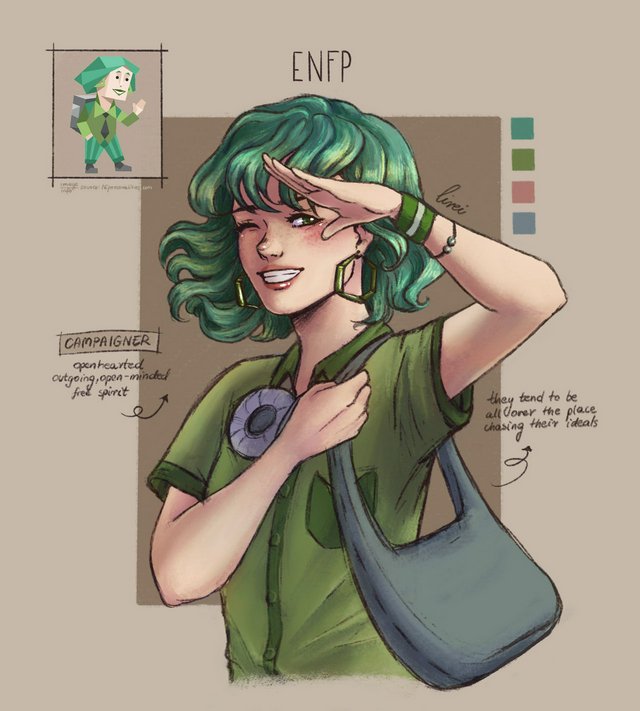
Fleabag’s personality is a classic, albeit troubled, manifestation of the ENFP type. Her dominant Extraverted Intuition (Ne) is constantly active, scanning her environment for possibilities, connections, and absurdities. This fuels her rapid-fire wit, her ability to see the underlying dynamics in any social situation, and her tendency to jump from one chaotic life path or sexual encounter to another. Her narration to the camera is a direct expression of Ne, as she explores endless interpretive angles on her own reality. Her auxiliary Introverted Feeling (Fi) provides her core values and a deep, albeit buried, well of emotion. Her actions are ultimately guided by a strong internal moral compass (evident in her love for her sister and her late friend) and intense personal feelings, but these are often obscured by the persona she projects. She judges herself and others based on this internal value system, leading to her self-loathing and her contempt for hypocrisy. Her inferior Introverted Sensing (Si) is her Achilles’ heel. She is trapped by past traumas—the death of her mother and best friend—but refuses to process them healthily. Instead, she engages in repetitive, self-destructive patterns (low Si) and flees from nostalgia or stable routine, which she finds suffocating. Her growth in Season 2 involves reluctantly engaging with her past and her pain. Her tertiary Extraverted Thinking (Te) emerges in bursts of blunt, often cruel, honesty and in pragmatic, if misguided, attempts to fix her cafe’s problems, but it is often overridden by her Ne impulsivity and Fi turmoil. Her interpersonal style is classic ENFP: charming and magnetically engaging, yet incapable of maintaining healthy intimacy because her fear of vulnerability (inferior Si) causes her to flee or sabotage.