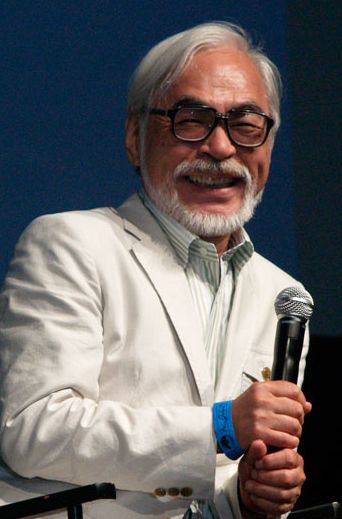
Miyazaki’s personality is quintessentially INFP, driven by a dominant Introverted Feeling (Fi). His work is a direct expression of his deeply held personal values: a reverence for nature, a belief in pacifism, and a focus on the inner strength and complexity of individuals, especially young girls. He is not creating for mass appeal but to manifest his own moral and aesthetic universe. His decision-making is guided by this internal compass, often leading him to reject commercial trends and industry norms, as seen in his steadfast commitment to hand-drawn animation and his complex, non-formulaic narratives.
His auxiliary Extraverted Intuition (Ne) is the engine of his boundless creativity. It allows him to synthesize disparate ideas—folklore, aviation, environmental science, European architecture—into wholly original and wondrous worlds. This function fuels the exploratory, ‘what-if’ nature of his storytelling, where spirits inhabit bathhouses and castles walk on mechanical legs. However, this Ne is filtered through his Fi, ensuring every imaginative leap serves his core thematic vision rather than mere spectacle.
His tertiary Introverted Sensing (Si) manifests in his nostalgic yet detailed craftsmanship. He draws heavily on his own childhood memories and a meticulous recollection of sensory details—the way light filters through trees, the design of real aircraft, the texture of traditional Japanese life. This combines with his Fi to create a longing for a purer, often lost, world. His inferior Extraverted Thinking (Te) appears in his legendary, often gruff, perfectionism in the studio. He demands exacting standards from his team and himself, a driven focus on executing his vision to the highest technical quality, which can sometimes erupt as impatience or frustration when reality falls short of his ideal.
Growth for an INFP like Miyazaki involves integrating this inferior Te in a healthier manner—channeling that drive without burnout or excessive criticism. His later years show some movement here, as he has repeatedly ‘retired’ only to return, driven by a Te-like need to complete a final statement or master a new technique (like CGI in ‘The Boy and the Heron’), all in service of his Fi-Ne vision. His legacy is that of a visionary who remained true to his inner world, using his imaginative gifts to craft universal parables of heart and conscience.