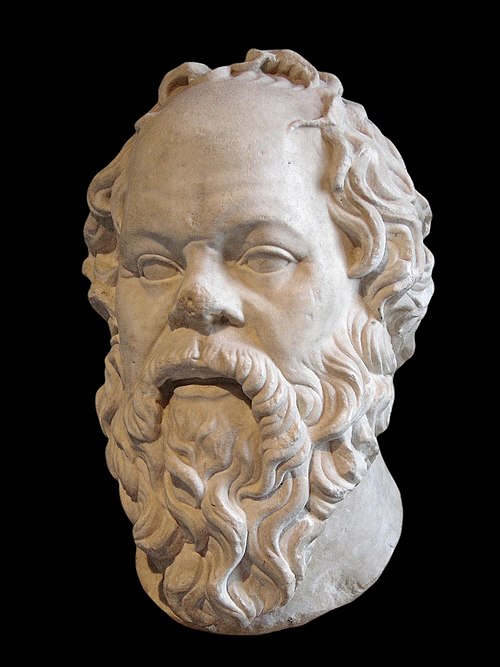
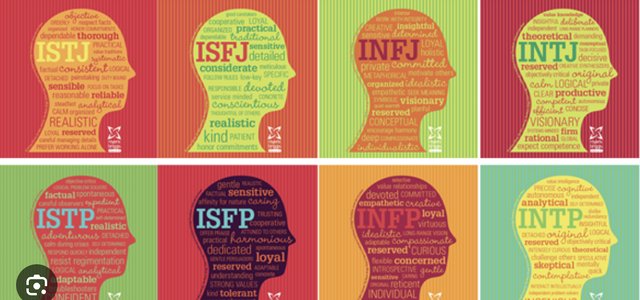
Socrates is a quintessential INTP, driven by a dominant Introverted Thinking (Ti) function. His entire life’s work centered on deconstructing and analyzing concepts like justice, virtue, and knowledge to build a coherent, logical internal framework. He was not interested in proclaiming truths but in testing them through rigorous logical cross-examination. This Ti dominance manifested as a relentless pursuit of intellectual consistency and a deep skepticism of unexamined beliefs, which often put him at odds with societal norms and established authorities.
His auxiliary Extraverted Intuition (Ne) is evident in his famous Socratic method. By asking probing, open-ended questions, he explored myriad possibilities, implications, and contradictions within his interlocutors’ statements. This Ne-driven dialogue was not about winning an argument but about exploring the conceptual landscape from every angle to reach a clearer definition or to expose a logical flaw. His playful yet devastating style of questioning demonstrates a generative, pattern-seeking mind that thrived on intellectual exploration.
Socrates’ tertiary Introverted Sensing (Si) can be seen in his references to traditional Athenian values and oracles (like the one at Delphi that declared him the wisest) as starting points for his inquiries. However, he used these established data points not to uphold tradition, but as fodder for his Ti-Ne analysis. His inferior Extraverted Feeling (Fe) is visible in his stated concern for the ‘care of the soul’ of his fellow citizens and his sense of a divine mission to philosophize. Yet, this Fe was underdeveloped in a conventional sense; he famously neglected social niceties, family wealth, and political favor, prioritizing truth over harmony, which ultimately led to his social alienation and trial.