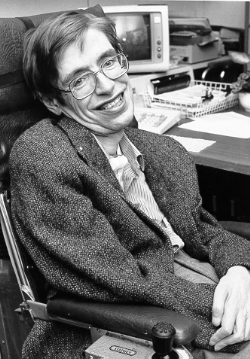
Stephen Hawking exemplifies the quintessential INTP personality type. His dominant Introverted Thinking (Ti) was the engine of his genius, driving him to construct intricate, internally consistent logical models of the universe. He was fundamentally motivated by understanding the underlying principles of reality, deconstructing complex cosmological phenomena into elegant theoretical frameworks. His work was not about applying known knowledge but about questioning foundational assumptions and building new systems of understanding from the ground up. This Ti dominance made him an independent, often stubborn thinker, more interested in the truth of an idea than its popularity or immediate utility.
His auxiliary Extraverted Intuition (Ne) provided the ‘what if’ spark that fueled his most famous insights. This function allowed him to make novel connections between disparate ideas, such as linking quantum mechanics, thermodynamics, and general relativity to conceive of Hawking radiation. It also manifested in his ability to communicate complex topics through imaginative analogies and his famously dry, often playful wit. His tertiary Introverted Sensing (Si) likely provided a repository of established scientific facts and personal history, which he could reference and, with his dominant Ti, often challenge. His inferior Extraverted Feeling (Fe) was less developed but surfaced in his later-career role as a public intellectual and science communicator, where he expressed concern for humanity’s future and used his fame to advocate for scientific inquiry and disability rights, albeit often in a more abstract, principled way than a personally emotive one.
As an Enneagram 5w4, Hawking’s core motivation was to understand the world to achieve competence and avoid feeling helpless or incapable—a drive intensified by his physical condition. The 5’s desire for mastery and hoarding of knowledge (in his case, of the cosmos) is clear. The 4 wing added a streak of individualism, a touch of romanticism about the universe’s mysteries, and a unique, recognizable personal style that made him an icon beyond just academia. His high Openness and Conscientiousness scores reflect his groundbreaking ideas and relentless dedication to his work. Lower Extraversion and mid-range Agreeableness align with his preference for deep, intellectual engagement over socializing and his reputation for being intellectually combative and dismissive of ideas he found illogical.