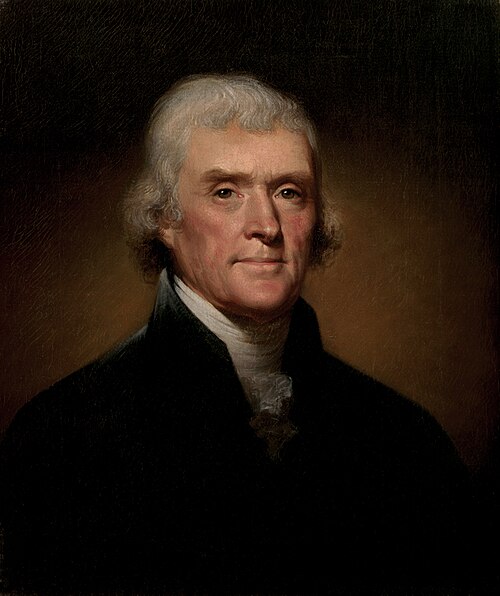
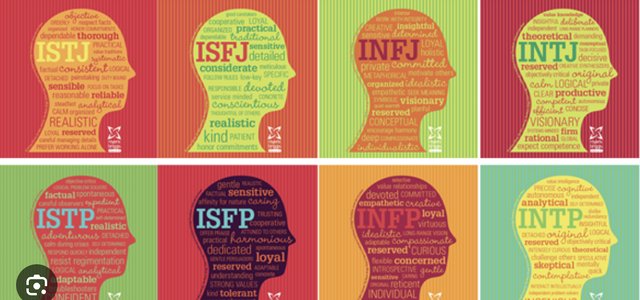
Thomas Jefferson exemplifies the INTP personality type, driven by a dominant Introverted Thinking (Ti) function. His mind was a meticulously organized internal system for analyzing the world. He sought logical coherence in principles like natural rights and republican government, famously constructing the elegant, deductive argument of the Declaration of Independence from a ‘self-evident’ first principle. This Ti dominance made him a relentless analyzer and classifier, as seen in his vast collections of data on topics ranging from flora and fauna to vocabularies and weather patterns. He preferred refining his internal models of how the world should work over engaging in the messy, extroverted fray of political deal-making, which he often found distasteful.
His auxiliary Extraverted Intuition (Ne) fueled his boundless intellectual curiosity and visionary outlook. Jefferson was a quintessential Renaissance man, fascinated by architecture, paleontology, linguistics, agriculture, and invention. Ne allowed him to see connections between disparate fields and imagine future possibilities for the American republic. However, this function, paired with Ti, often led him to prioritize abstract ideals and theoretical solutions over grounded, sensory realities (inferior Extraverted Sensing - Se). His architectural designs, like Monticello, were marvels of innovative thought but were often impractical and constantly under renovation.
Jefferson’s interpersonal dynamics and growth areas highlight his tertiary Introverted Sensing (Si) and inferior Extraverted Feeling (Fe). Si provided him with a deep reverence for tradition and historical precedent (as in his admiration for Saxon law) and a personal attachment to his routines and estates. However, his inferior Fe manifested in a profound discomfort with direct emotional confrontation and public conflict. He preferred written correspondence over speeches, used surrogates for political attacks, and struggled to reconcile the emotional and human realities of slavery with his intellectual ideals. This Fe blind spot is central to the most painful contradictions of his character: advocating for human liberty while enslaving people, and espousing equality while holding deeply prejudiced views. His growth would have involved integrating a healthier Fe—acknowledging and taking responsibility for the human impact of his systems and actions, moving beyond theoretical benevolence to practical empathy.