Grendel - INFP Personality Type

Grendel

INFP - Mediator

Category

Literature

Nationality

Danish Lands (as per the poem's setting)

Occupation

Monster / Antagonist

About Grendel

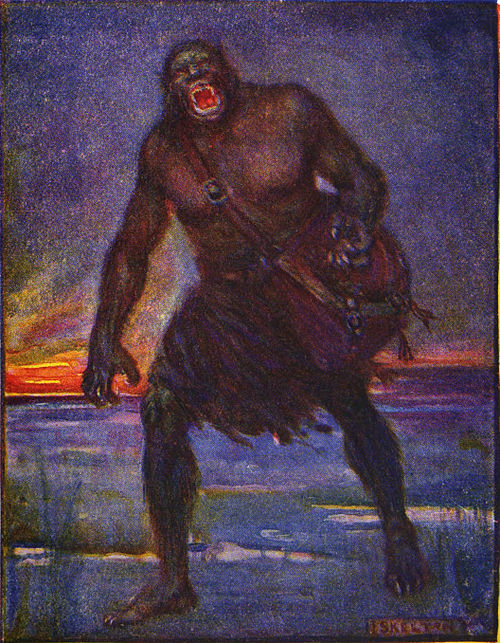
Grendel is the primary antagonist of the Old English epic poem 'Beowulf'. He is a monstrous, man-eating creature descended from the biblical Cain, known for his relentless attacks on Heorot, the mead-hall of King Hrothgar. His significance lies in his role as a symbol of existential isolation, chaos, and the inevitable conflict between monstrous outsider and human society.

Personality Profile: INFP

Confidence: 85%

Personality Analysis

Grendel is a profound example of a deeply wounded and alienated INFP. His dominant Introverted Feeling (Fi) is central to his character; he is governed by a powerful, internal value system that is utterly at odds with the world he observes. He is not merely a mindless beast but a being tortured by his own consciousness, constantly evaluating his existence and finding it meaningless and painful. His Fi drives his profound sense of isolation and his perception of the Danes’ joy in Heorot as a personal, existential insult—a celebration of a world from which he is forever excluded. This core feeling of alienation is the source of his rage and violence.

His auxiliary Extraverted Intuition (Ne) manifests in his philosophical musings and his tendency to interpret the world around him through a lens of possibility and connection, albeit bleak ones. He observes the Danes, the Shaper’s songs, and the natural world, weaving them into a complex, nihilistic narrative about the absurdity of existence. However, his Ne is trapped in a negative feedback loop with his Fi, leading him to imagine only scenarios of rejection and futility rather than hopeful alternatives. His tertiary Introverted Sensing (Si) fuels his brooding over past experiences and traumas, particularly his earliest memories of being cast out, which he revisits with bitter clarity.

His inferior Extraverted Thinking (Te) is his greatest area of dysfunction and stress. When his deep internal turmoil becomes unbearable, he lashes out with brutal, chaotic force—a crude, destructive parody of Te’s desire for external control and efficiency. He cannot organize the world or his place in it logically; instead, he seeks to tear down the ordered systems (like Heorot’s society) that mock his internal chaos. His growth, tragically stunted, would involve integrating a healthier Te to find a constructive outlet for his Fi-Ne insights, but he remains trapped in a cycle of feeling, misinterpretation, and violent reaction until his demise.

Supporting Evidence

In John Gardner’s novel ‘Grendel’, which provides the most detailed psychological portrait, the monster spends years observing the Danes from a distance, philosophizing about their meaning-making through art and community, which highlights his Fi-Ne axis. His violent raids on Heorot are not for sustenance alone but are explicitly triggered by the sounds of joy and fellowship, which he perceives as a deliberate mockery of his own loneliness, a classic Fi-driven reaction to a violation of internal values. His lengthy, poetic soliloquies about the nature of the universe, time, and his cursed lineage demonstrate intense introspection (Fi) coupled with abstract, connective thinking (Ne). His final, futile confrontation with Beowulf, where he is physically and existentially dismantled, showcases his inferior Te collapse—his brute force and rage are systematically and logically overcome by a hero representing order and decisive action.

Cognitive Function Stack

Confidence: 85%

The cognitive function stack represents how an individual processes information and makes decisions based on Jungian personality type theory.

Auxiliary Function: Ne

Extraverted Intuition - Seeing possibilities and connections in the external world.

Dominant Function: Fi

Introverted Feeling - Making decisions based on internal values and personal ethics.

Inferior Function: Te

Extraverted Thinking - Organizing and structuring the external world logically and efficiently.

Tertiary Function: Si

Introverted Sensing - Recalling detailed information and maintaining traditions.

Enneagram Personality Profile:

Confidence: 85%

4w5

Big Five Personality Traits

Confidence: 85%

The Big Five personality traits represent the five broad dimensions of personality that are commonly used to describe human personality.

Openness 0%
Conscientiousness 0%
Extraversion 0%
Agreeableness 0%
Neuroticism 0%