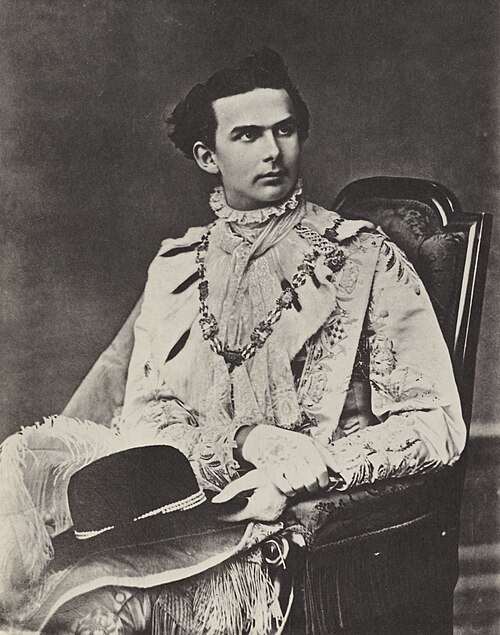
Ludwig II is a quintessential INFP, driven by a dominant Introverted Feeling (Fi). His personality was defined by a rich, intensely personal inner world of values, ideals, and aesthetics. He judged everything against his internal standard of beauty, romance, and divine monarchy, which often clashed with the pragmatic, political realities of his time. His decisions, from funding Richard Wagner to building his castles, were not logical or strategic but were profound expressions of his personal vision and emotional needs. This strong Fi made him appear stubborn, melancholic, and utterly indifferent to public opinion or conventional expectations of a king.
His auxiliary Extraverted Intuition (Ne) fueled his visionary and fantastical pursuits. He was not content with the mundane present; his mind constantly explored possibilities of a more perfect, mythic world. This is evident in the architectural designs of his castles, which synthesized elements from Wagnerian opera, Germanic legend, and an idealized medieval past into something entirely new. Ne also contributed to his mercurial nature, with grand projects being constantly revised and new, even more ambitious plans conceived before old ones were finished. However, this Ne was in service to his Fi, seeking external symbols and narratives to manifest his inner ideals.
His underdeveloped Extraverted Thinking (Te) and Introverted Sensing (Si) further explain his life’s trajectory. His inferior Te manifested as a profound neglect for practical administration, state finances, and diplomatic strategy. He saw such matters as vulgar and oppressive, leading to catastrophic debt and political isolation. His tertiary Si was expressed nostalgically, not as a grounding force but as a romanticized, aesthetic connection to a fictionalized past. He didn’t learn from history’s lessons but used its imagery to escape the present. This function stack created a king tragically unsuited for his role—a dreamer who viewed his kingdom not as a state to govern, but as a canvas for his personal artistic and emotional expression, ultimately leading to his deposition.