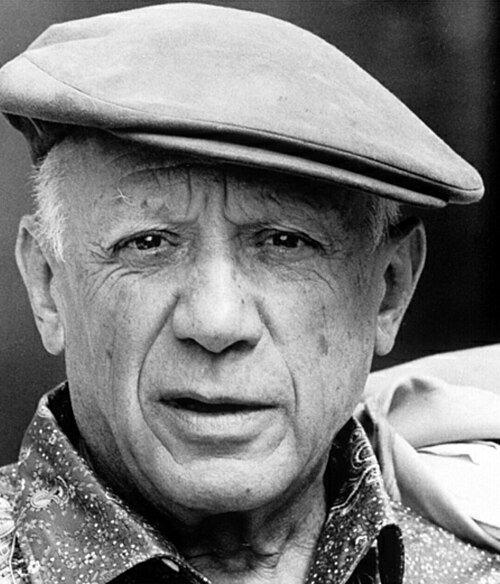
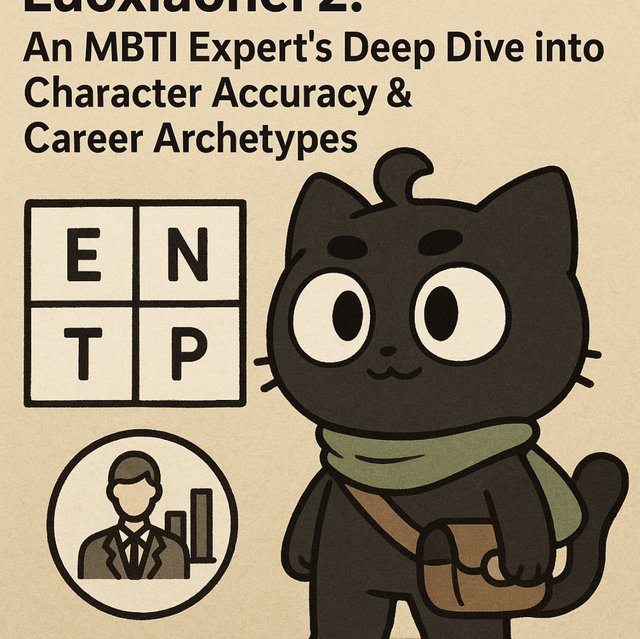
Picasso’s personality archetype is a quintessential ENTP (The Visionary). His dominant Extraverted Intuition (Ne) drove his insatiable need to explore possibilities, connect disparate ideas, and break all artistic rules. He was never satisfied with a single style, constantly leaping from Blue Period to Rose Period to Cubism to Surrealism and beyond, seeing the world as a playground of potential forms. This function made him a conceptual revolutionary, more interested in the ‘idea’ of art and perception than in perfecting a single technique. His auxiliary Introverted Thinking (Ti) provided the internal logical framework for his explorations. While his output seemed chaotic, it was underpinned by a rigorous, analytical deconstruction of form and space, as seen in the geometric logic of Analytic Cubism. He needed to understand and systematize his visual experiments according to his own internal rules. His tertiary Extraverted Feeling (Fe) manifested in his magnetic charisma, his need for an audience and a stimulating social circle (the ‘bande à Picasso’), and his ability to work collaboratively with figures like Braque. However, it could also appear as a desire to provoke public reaction, both positive and negative. His inferior Introverted Sensing (Si) is seen in his disregard for tradition, convention, and the ‘way things have always been done’ in art. While he could reference art history (as in his reinterpretations of Velázquez), he did so only to subvert it, showing a classic ENTP struggle with consistency, routine, and sentimental attachment to the past.