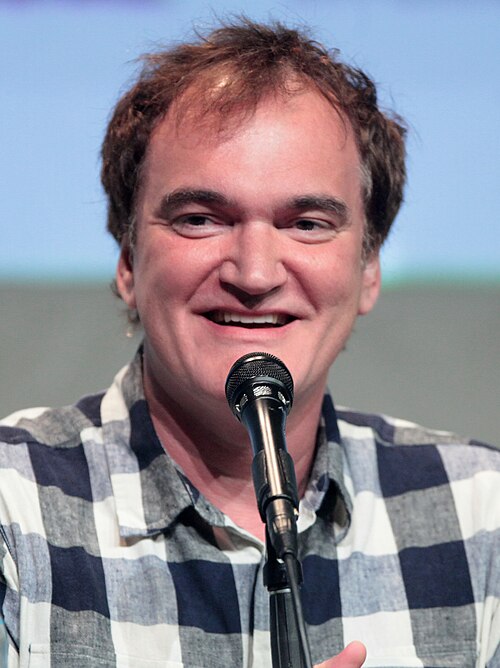
Quentin Tarantino - ENTP Personality Type

Quentin Tarantino

ENTP - Debater

Category

Entertainment

Nationality

American

Occupation

filmmaker

About Quentin Tarantino

Quentin Jerome Tarantino (/ˌtærənˈtiːnoʊ/; born March 27, 1963) is an American filmmaker, actor, and author. His films are characterized by graphic violence, extended dialogue often featuring much profanity, and references to popular culture. His work has earned a cult following alongside critical and commercial success; he has been named by some as the most influential director of his generation and has received numerous awards and nominations, including two Academy Awards, two BAFTA Awards, and four Golden Globe Awards. His films have grossed more than $1.9 billion worldwide.[1] Tarantino began his career with the independent crime film Reservoir Dogs (1992). His second film, the crime comedy-drama Pulp Fiction (1994), was a major success and won numerous awards, including the Cannes Film Festival's Palme d'Or and the Academy Award for Best Original Screenplay. He next wrote and starred in the action horror film From Dusk till Dawn (1996). His third film as director, Jackie Brown (1997), paid homage to blaxploitation films.

Personality Profile: ENTP

Confidence: 90%

Personality Analysis


Detailed Analysis

1. MBTI Type Assessment

  • Extraversion (E): Tarantino thrives in social and collaborative environments, often engaging in lively debates and interviews. His public persona is energetic and charismatic.
  • Intuition (N): His films are rich in abstract concepts, nonlinear storytelling, and symbolic references (e.g., Pulp Fiction’s fragmented narrative).
  • Thinking (T): He prioritizes logical consistency and bold artistic choices over emotional appeasement, often defending controversial content in his films.
  • Perceiving (P): His creative process is improvisational, favoring spontaneity over rigid structure (e.g., rewriting scripts on set).

2. Cognitive Function Stack

  • Dominant: Extraverted Intuition (Ne): Generates endless creative ideas, blending pop culture, history, and genre subversion (Kill Bill’s homage to martial arts films).
  • Auxiliary: Introverted Thinking (Ti): Structures his ideas with meticulous internal logic (e.g., Reservoir Dogs’ precise heist mechanics).
  • Tertiary: Extraverted Feeling (Fe): Uses humor and audience engagement to connect, though secondary to his vision (e.g., witty dialogue in Inglourious Basterds).
  • Inferior: Introverted Sensing (Si): Occasionally draws from nostalgic influences (e.g., Once Upon a Time in Hollywood’s 1960s fetishization).

3. Key Personality Traits

  1. Innovative – Constantly reinvents genres (e.g., Django Unchained as a revisionist Western).
  2. Debative – Enjoys intellectual clashes (e.g., defending violence in film as artistic expression).
  3. Nonconformist – Rejects Hollywood norms (e.g., retaining final cut privileges).
  4. Charismatic – Commands attention in interviews and public appearances.
  5. Spontaneous – Adapts scripts mid-production (Death Proof’s improvised car chase).

4. Behavioral Pattern Analysis

  • Creative Process: Prefers organic development over strict planning (e.g., Pulp Fiction’s nonlinear structure emerged during writing).
  • Collaboration: Energized by dynamic partnerships (e.g., frequent collaborations with Samuel L. Jackson).
  • Risk-Taking: Embraces controversial themes (e.g., The Hateful Eight’s racial tension).

5. Enneagram Type Analysis

  • Type 7w8 (“The Maverick”): Combines 7’s enthusiasm for new experiences with 8’s assertiveness.
    • Core Fear: Being trapped in boredom or limitation (evident in his genre-hopping career).
    • Wing Influence: 8’s aggression fuels his confrontational style (e.g., public feuds with critics).

6. Big Five Traits Analysis

  • Openness (O:90): Exceptionally high—experiments with bold narratives and visuals.
  • Conscientiousness (C:65): Moderately disciplined; balances improvisation with detailed research.
  • Extraversion (E:75): Outspoken and socially engaged, though not excessively gregarious.
  • Agreeableness (A:60): Moderately cooperative but prioritizes artistic integrity over consensus.
  • Neuroticism (N:40): Low—exudes confidence and handles criticism resiliently.

Supporting Evidence

  • MBTI/Ne Dominance: Pulp Fiction’s nonlinear plot and Kill Bill’s genre fusion demonstrate Ne’s exploratory nature.
  • Ti Auxiliary: His detailed explanations of filmmaking techniques (e.g., Reservoir Dogs’ torture scene logic).
  • Enneagram 7w8: Career shifts from crime films (Jackie Brown) to war epics (Inglourious Basterds) reflect 7’s novelty-seeking.
  • Big Five: High Openness aligns with his eclectic filmography; lower Agreeableness fits his uncompromising stance on violence.

Supporting Evidence

Conclusion: Tarantino’s ENTP-7w8 profile underscores his role as a boundary-pushing auteur, blending intellectual rigor with rebellious creativity.

Cognitive Function Stack

Confidence: 90%

The cognitive function stack represents how an individual processes information and makes decisions based on Jungian personality type theory.

Auxiliary Function: In

Introverted Function - Focusing on and drawing energy from internal thoughts, feelings, and reflections.

Dominant Function: Ex

Extraverted Function - Focusing on and drawing energy from the external world, people, and activities.

Inferior Function: In

Introverted Function - Focusing on and drawing energy from internal thoughts, feelings, and reflections.

Tertiary Function: Ex

Extraverted Function - Focusing on and drawing energy from the external world, people, and activities.

Enneagram Personality Profile:

Confidence: 90%

7w8

Big Five Personality Traits

Confidence: 90%

The Big Five personality traits represent the five broad dimensions of personality that are commonly used to describe human personality.

Openness 0%
Conscientiousness 0%
Extraversion 0%
Agreeableness 0%
Neuroticism 0%

Similar ENTP Characters

Explore other characters with similar personality traits