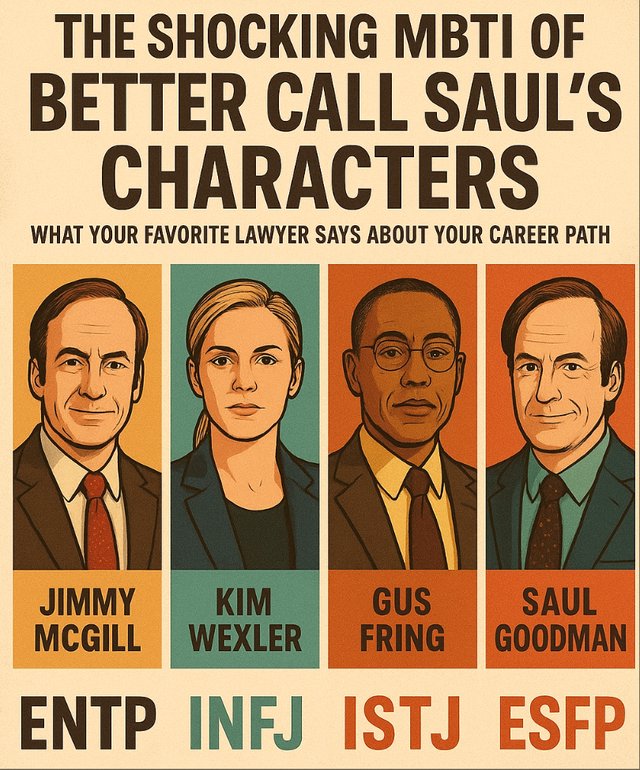
MBTI Type: ENTP
Enneagram Type: 7w8
Big Five Traits: O:95, C:55, E:85, A:40, N:30
Detailed Analysis
1. MBTI Type Assessment: ENTP (The Debater/Visionary)
- E - Extraversion: Saul is a quintessential extravert. He draws energy from interaction, thrives in the spotlight of a courtroom or his own garish commercials, and is a master of persuasion and social dynamics. He is talkative, expressive, and rarely seen in prolonged isolation without becoming visibly drained (as seen in his “Gene” persona).
- N - Intuition: He is not focused on minute details but on patterns, possibilities, and connections. He doesn’t see a legal system; he sees a game with loopholes to be exploited. He constantly generates new, often outlandish, schemes and business ideas (e.g., “Ice Station Zebra Associates,” cell phones for criminals, the “Chicago Sunroof”). He lives in a world of “what could be” rather than “what is.”
- T - Thinking: Saul’s decisions are based on a cost-benefit analysis and logical efficiency, not on personal values or harmony. He is pragmatic, strategic, and often amoral. He views emotions as variables to be manipulated in others (e.g., juries, clients) or as obstacles in himself. His advice is brutally logical, even when it’s cold (e.g., recommending murdering Badger or Jesse to solve problems).
- P - Perceiving: He is spontaneous, adaptable, and thrives on improvisation. He rarely has a rigid, long-term plan but instead reacts to opportunities and crises as they arise, often winging elaborate cons and legal strategies. His life and office are chaotic, and he prefers to keep his options open rather than commit to a single, structured path.
2. Cognitive Function Stack Analysis
- Dominant Function: Extraverted Intuition (Ne): This is Saul’s greatest strength. He excels at brainstorming, connecting disparate ideas, and seeing possibilities no one else can. He uses Ne to devise ingenious legal strategies, craft persuasive narratives, and concoct elaborate cons. He sees every situation as a web of potential moves and outcomes.
- Auxiliary Function: Introverted Thinking (Ti): He uses Ti to build internal logical frameworks for his Ne ideas. He deconstructs systems (like the law) to understand how they really work, not how they’re supposed to work. This function provides the internal reasoning for his schemes, ensuring they are internally consistent and effective, even if ethically bankrupt.
- Tertiary Function: Extraverted Feeling (Fe): Saul uses Fe to read people and rooms, allowing him to be a master manipulator and showman. He tailors his persona—whether it’s “Slippin’ Jimmy,” “Saul Goodman,” or “Gene Takovic”—to elicit specific emotional responses from others. He uses charm, flattery, and theatrics to achieve his goals.
- Inferior Function: Introverted Sensing (Si): Saul’s relationship with the past is problematic. He often ignores or rebels against traditional rules and established procedures (low Si). However, in times of extreme stress (as Gene), he becomes hyper-vigilant about past mistakes and patterns, paranoid that history will repeat itself and he will be caught.
3. Key Personality Traits Summary
- Resourceful and Ingenious: An exceptional problem-solver who can always find a creative, if unconventional, way out of a jam.
- Charming and Manipulative: Uses his wit and charisma to persuade, deceive, and control those around him for his own benefit.
- Amoral and Pragmatic: Prioritizes effectiveness and survival over ethical considerations. His moral compass is highly flexible.
- Restless and Hedonistic: Constantly seeks stimulation, novelty, and excitement, and is driven by a desire to avoid boredom and pain.
- Resilient and Adaptive: Possesses an almost cockroach-like ability to survive disaster, reinvent himself, and land on his feet.
4. Behavioral Pattern Analysis
Saul’s behavior is characterized by a cycle of opportunity-seeking and crisis management. His Ne-Ti core constantly scans the environment for angles to exploit. When he finds one, he acts impulsively (P), deploying a combination of logical strategy (Ti) and emotional manipulation (Fe) to execute his plan. The consequences often lead to a larger crisis, which he then attempts to solve with an even bigger, riskier scheme. This pattern demonstrates a fundamental avoidance of introspection and a refusal to learn from past mistakes in a conventional way, instead choosing to adapt his methods externally.
5. Enneagram Type Analysis: Type 7w8 (The Entertainer with a “Maverick” Wing)
Saul is a classic Enneagram 7, the Enthusiast. His core motivation is to avoid pain and deprivation and to seek satisfaction and stimulation. He is a consummate optimist, always believing the next scheme will be the big score that brings him happiness and freedom. His “wing” is 8 (The Challenger), which adds a layer of assertiveness, lust for life, and a confrontational, sometimes aggressive edge to his personality. He isn’t just seeking fun (7); he wants to assert his will on the world and grab what he wants (8). This 7w8 combination perfectly explains his hedonistic, fast-talking, and at times intimidating demeanor.
6. Big Five Personality Traits Analysis
- Openness (O:95): Extremely high. He is intellectually curious, creative, and open to new, unconventional, and immoral experiences.
- Conscientiousness (C:55): Medium/Low. While he can be disciplined in executing a con, he is fundamentally impulsive, flexible, and disorganized. He lacks the principle-driven dutifulness of high Conscientiousness.
- Extraversion (E:85): Very high. He is assertive, gregarious, excitement-seeking, and cheerful (outwardly).
- Agreeableness (A:40): Low. He is highly antagonistic, competitive, manipulative, and has little concern for the well-being of others when it conflicts with his goals.
- Neuroticism (N:30): Low. He is generally confident, resilient, and calm under pressure. He suppresses anxiety and fear through activity and scheming, though it surfaces intensely in his “Gene” life when he can no longer run.
Supporting Evidence