Richard Phillips Feynman - ENTP Personality Type

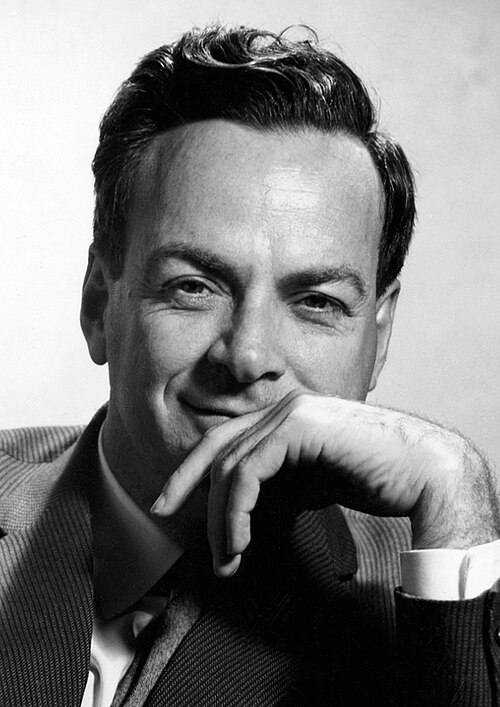
Richard Phillips Feynman

ENTP - Debater

Category

Science

Nationality

American

Occupation

Theoretical Physicist, Educator

About Richard Phillips Feynman

Richard Feynman was a Nobel Prize-winning American theoretical physicist. He is best known for his work in quantum electrodynamics, his path integral formulation of quantum mechanics, and his role in the investigation of the Space Shuttle Challenger disaster. He was also renowned as a brilliant, charismatic, and unconventional educator and science communicator.

Personality Profile: ENTP

Confidence: 85%

Personality Analysis

Richard Feynman exemplifies the ENTP (The Ne-Ti-Fe-Si) personality type. His dominant function, Extraverted Intuition (Ne), was his engine. He was a consummate brainstormer, seeing patterns, connections, and possibilities everywhere. This drove his revolutionary scientific insights, such as visualizing quantum mechanics through sum-over-paths, and his relentless, playful curiosity about everything from physics to safecracking, bongo drums, and Mayan hieroglyphs. His mind was a constant generator of ‘what if’ scenarios, making him a formidable and joyful intellectual explorer.

His auxiliary function, Introverted Thinking (Ti), provided the internal logical framework to structure and validate the torrent of Ne ideas. Feynman was fiercely independent in his reasoning, famously distrustful of authority and unproven dogma. He built his own profound understanding of physics from first principles, often discarding standard textbook methods to derive results in his own unique, elegant way. This Ti gave his Ne explorations rigor and depth, allowing him to solve problems others found intractable by thinking around them in novel ways.

His tertiary function, Extraverted Feeling (Fe), manifested in his charismatic showmanship and deep desire to communicate and connect. He was a legendary lecturer, using humor, vivid analogies, and dramatic demonstrations to make complex ideas accessible and exciting. He thrived on intellectual debate and the energy of an audience. However, Fe in the tertiary position can also lead to a mischievous, sometimes irreverent edge; Feynman enjoyed pranks and could be bluntly dismissive of ideas or people he found pompous or illogical, showing lower agreeableness.

His inferior function, Introverted Sensing (Si), represents his area of potential growth and stress. Feynman had a noted disregard for tradition, convention, and established procedures for their own sake. He rebelled against bureaucratic norms and formal authority. Under stress, he might neglect practical details or become impatient with routine. However, in his later life, particularly during the Challenger investigation, he demonstrated growth in this function by meticulously focusing on concrete data (the O-ring’s material properties in cold weather) to reveal a catastrophic truth that the established process had overlooked.

Supporting Evidence

His development of the Feynman Diagrams, which provided a visual, intuitive (Ne) yet mathematically rigorous (Ti) way to handle complex particle interactions. His legendary Caltech lectures showcase his Ne (creative explanations) and Fe (charismatic communication). His approach to the Challenger investigation—bypassing bureaucracy, conducting a simple public experiment with ice water and an O-ring—demonstrates Ti/Ne skepticism and a hands-on, proof-driven method. His lifelong hobbies (painting, playing bongos, lock-picking) reveal his Ne-driven curiosity for diverse experiences. His famous anecdote about challenging mathematicians to define ‘tangent’ without using calculus illustrates his Ti-driven need to understand fundamentals and his playful, challenging (Fe-tertiary) style.

Cognitive Function Stack

Confidence: 85%

The cognitive function stack represents how an individual processes information and makes decisions based on Jungian personality type theory.

Auxiliary Function: Ti

Introverted Thinking - Analyzing and categorizing information logically and precisely.

Dominant Function: Ne

Extraverted Intuition - Seeing possibilities and connections in the external world.

Inferior Function: Si

Introverted Sensing - Recalling detailed information and maintaining traditions.

Tertiary Function: Fe

Extraverted Feeling - Connecting with others and maintaining social harmony.

Enneagram Personality Profile:

Confidence: 85%

7w6

Big Five Personality Traits

Confidence: 85%

The Big Five personality traits represent the five broad dimensions of personality that are commonly used to describe human personality.

Openness 0%
Conscientiousness 0%
Extraversion 0%
Agreeableness 0%
Neuroticism 0%

Similar ENTP Characters

Explore other characters with similar personality traits

Related Articles

Articles featuring Richard Phillips Feynman or related personality topics