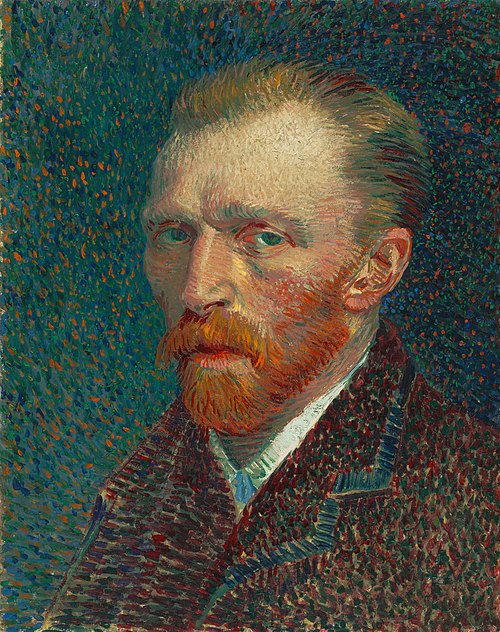
Van Gogh’s personality strongly aligns with the INFP type, driven by a dominant Introverted Feeling (Fi). His art and letters reveal a profound inner world of intense personal values, morality, and emotional depth. He was guided by an authentic, individualistic compass, often clashing with societal norms and the art establishment of his time. His deep empathy for peasants and the downtrodden, and his search for spiritual meaning through art, are classic manifestations of a rich Fi core. His auxiliary Extraverted Intuition (Ne) is evident in his exploratory use of color, symbolic content, and his constant search for new ideas and artistic inspirations from Japanese prints to Impressionism. This Ne fed his creativity but also contributed to his restless movement between locations and styles, seeking a personal truth. Van Gogh’s tertiary Introverted Sensing (Si) appears in his nostalgic attachments (e.g., his Dutch period’s somber tones, memories of his childhood) and his repetitive, almost ritualistic painting of certain subjects like his bedroom or sunflowers. His inferior Extraverted Thinking (Te) was a significant area of struggle. He was notoriously poor at managing practical affairs, finances, and career advancement. His difficulty structuring his external world and his bouts of frustration when his internal vision couldn’t be realized or accepted externally contributed to his profound sense of failure and crises. His interpersonal dynamics were marked by a longing for deep, meaningful connection (Fi) but were often thwarted by his intensity, sensitivity, and social awkwardness, leading to famous fallings-out, like with Gauguin. His growth areas, tragically, involved integrating a healthier Te to provide stability and finding a way to channel his immense Fi-Ne passion without it consuming him.