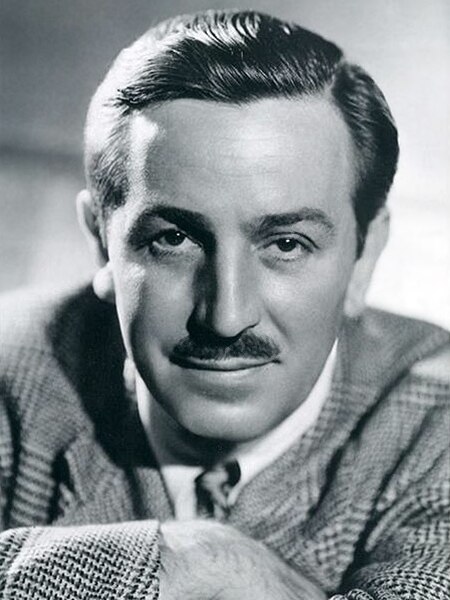
Walt Disney exemplifies the ENTP type, driven by Extraverted Intuition (Ne). His dominant function was a relentless generator of possibilities, seeing connections and future potentials where others saw limitations. This is evident in his leap from short cartoons to the first full-length animated feature (‘Snow White’), and later to the entirely new concept of the immersive, clean theme park. He was a classic ‘idea man,’ constantly brainstorming and pushing into uncharted territory. His auxiliary Introverted Thinking (Ti) provided the internal logical framework to deconstruct and refine these visions into workable systems, though he often relied on others for the granular execution. This Ti-Fe axis also explains his complex interpersonal style: he could be incredibly charming and inspiring (Fe), rallying his ‘Imagineers’ with a shared sense of purpose and family, yet also detached, critical, and stubborn when his internal logic was challenged.
As an ENTP, Disney was a persuasive entrepreneur and showman, not a hands-on technician. He excelled at selling his vision to financiers, audiences, and his staff. His decision-making was intuitive and future-oriented, often disregarding conventional wisdom and past failures (inferior Introverted Sensing, Si). However, under stress, this inferior Si could manifest as nostalgia for a idealized past (e.g., Main Street, U.S.A.) or a fixation on past grievances. His tertiary Fe developed strongly, fostering a powerful, paternalistic company culture, but it was often subservient to his visionary Ne and logical Ti, leading to an autocratic leadership style when his core vision was at stake.
Growth for an ENTP involves integrating their inferior function. For Disney, this meant learning to appreciate and systematize the past (Si) not just as nostalgia, but as a stable foundation. His later projects, like Disneyland, required immense logistical planning and attention to operational detail—a challenge for a dominant Ne user. His ability to eventually build an empire, not just conceive of one, suggests development in this area, though he remained fundamentally a provocateur and innovator who thrived on the next big idea, often leaving the management of success to others.