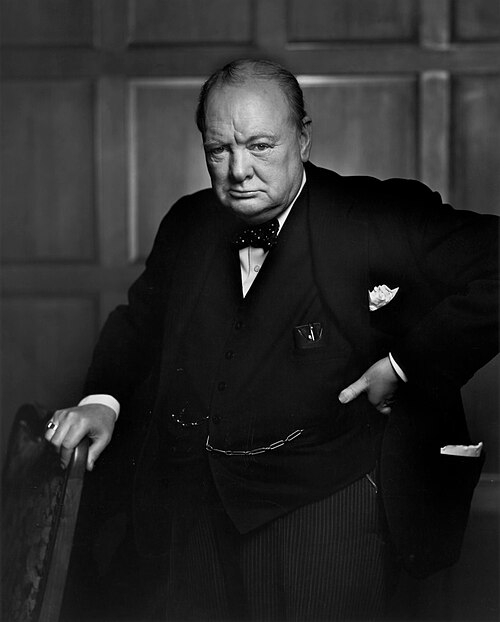
Winston Churchill is a quintessential ENTP. His dominant Extraverted Intuition (Ne) is evident in his boundless intellectual curiosity, his ability to see the ‘big picture’ and future possibilities, and his prolific generation of innovative, often unorthodox, strategic ideas. He constantly played with concepts, connections, and ‘what-if’ scenarios, from the Dardanelles campaign to the development of the tank. His auxiliary Introverted Thinking (Ti) provided the internal logical framework to analyze these ideas, craft intricate arguments, and structure his masterful historical writings and speeches with precision, even if his personal habits appeared chaotic. He valued truth and internal logical consistency in his worldview, even when it made him a political outsider for long periods.
His tertiary Extraverted Feeling (Fe) was a powerful tool he wielded with immense skill. While not naturally empathetic on a personal level, he understood the emotional currents of the nation and the need for morale. He used his Fe to connect with and inspire the British public through his radio broadcasts, tailoring his message to uplift and unite. His inferior Introverted Sensing (Si) manifested in his famous nostalgia for the British Empire and Victorian era, his deep reverence for history and tradition (which he studied voraciously), and his bouts of profound depression, which he called his ‘Black Dog’—a classic sign of an underdeveloped or stressed Si function.
Churchill’s decision-making style was bold, intuitive, and often contrarian. He relished debate and intellectual combat, using his sharp wit to dismantle opponents. Interpersonally, he could be charming and captivating but also domineering, impatient, and insensitive, a hallmark of the ENTP’s sometimes-blunt auxiliary Ti and lower Feeling functions. His growth areas involved managing his inferior Si—channeling his historical knowledge without being paralyzed by melancholy or nostalgia, and developing greater personal patience and consistency in administrative detail, areas where his perceiving dominance sometimes clashed with the demands of high office.