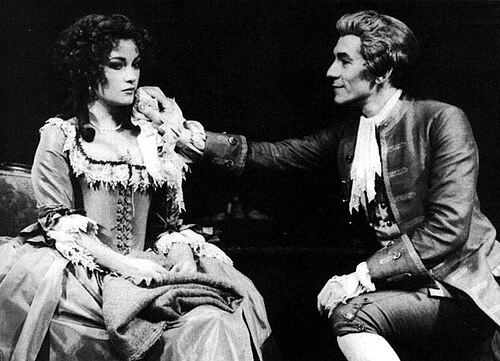
Salieri is a classic ISTJ, driven by a dominant Introverted Sensing (Si). He is a man of tradition, structure, and meticulous detail. His entire identity is built upon a lifetime of diligent work, faithful service to the court, and adherence to the established rules of musical composition and social decorum. He values order, duty, and a predictable, merit-based world where hard work is justly rewarded. His auxiliary Extraverted Thinking (Te) is evident in his efficient management of his career, his logical arguments about music’s purpose, and his practical, structured compositions. He seeks external validation through titles, positions, and the Emperor’s favor, viewing success through a lens of measurable achievement and social standing.
His tertiary Introverted Feeling (Fi) is where his deep, private turmoil resides. He made a ‘bargain’ with God: piety and good works in exchange for musical fame. This intensely personal value system is violated when he perceives Mozart, a ‘obscene child’, as God’s chosen vessel. His envy is not just professional; it is a profound spiritual and moral betrayal. His Fi fuels his righteous anger, his sense of injustice, and the intense, private shame and self-loathing that define his later years. His inferior Extraverted Intuition (Ne) manifests as his catastrophic inability to process Mozart’s genius. He cannot comprehend the chaotic, inspired, rule-breaking creativity (Ne) that Mozart embodies. Instead of seeing possibility, he sees only a terrifying, meaningless chaos that mocks his entire life’s work, leading to paranoia and a fixation on Mozart as a personal torment sent by God.
Salieri’s growth area, as with all ISTJs, lies in integrating a healthier relationship with his inferior Ne. A developed Salieri might have been able to appreciate innovation without feeling personally attacked, to see beyond rigid tradition to the new forms being born. Instead, he remains trapped in his Si-Te loop, using his practical skills (Te) to meticulously catalog his own misery and to scheme against Mozart, all while reinforcing his rigid worldview (Si). His ultimate tragedy is that of a competent, conscientious man who defines himself entirely by external structures and a personal pact, and whose psyche shatters when faced with a force of nature that operates outside those frameworks.