Hua Mulan - ISTJ Personality Type

Hua Mulan

ISTJ - Logistician

Category

Literature

Nationality

Chinese

Occupation

Warrior / Soldier

About Hua Mulan

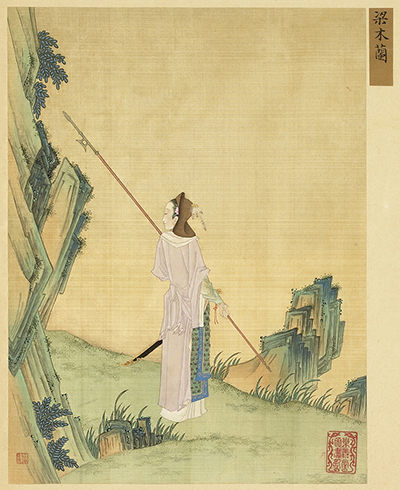
Hua Mulan is a legendary Chinese folk heroine from the Northern and Southern dynasties period. She is renowned for disguising herself as a man to take her elderly father's place in the army, serving for twelve years with great distinction. Her story, popularized by the 'Ballad of Mulan,' symbolizes filial piety, loyalty, bravery, and the challenging of traditional gender roles.

Personality Profile: ISTJ

Confidence: 85%

Personality Analysis

Hua Mulan exemplifies the ISTJ personality type, characterized by a dominant Introverted Sensing (Si) and auxiliary Extraverted Thinking (Te). Her primary motivation stems from a deep-seated, internalized sense of duty and tradition (Si), specifically the Confucian virtue of filial piety. This is not a fleeting emotion but a core principle that dictates her life-altering decision. She then executes this decision with remarkable efficiency and practicality (Te), systematically learning military skills, maintaining her disguise, and excelling in combat through discipline and adherence to the established rules of the army. Her tertiary Introverted Feeling (Fi) provides the strong personal conviction and moral compass that fuels her sacrifice, while her inferior Extraverted Intuition (Ne) is seen in her capacity for strategic, on-the-fly adaptation during warfare, though she generally prefers the known, reliable path over speculative possibilities.

Interpersonally, Mulan is reserved, focused on her tasks, and builds trust through consistent, reliable action rather than words. She leads by example and respects the chain of command, fitting seamlessly into the military’s hierarchical structure. Her loyalty to her family and comrades is absolute, but expressed through service rather than overt emotional displays. Her decision-making is overwhelmingly principled and logical; she weighs the practical necessity (her father’s frailty) against the societal rule (only men can serve), and her internal code compels her to break the rule to fulfill the higher duty.

Growth for an ISTJ like Mulan involves engaging more with her inferior function, Ne. Her legendary story itself represents a monumental break from convention, forcing her into a scenario of endless novel possibilities and hidden identities. Successfully navigating this for twelve years required her to develop strategic foresight and adaptability beyond rote procedure. A fully integrated Mulan would balance her formidable sense of duty and tradition with a greater openness to innovative solutions and a recognition that rules, while generally good, must sometimes be re-evaluated in light of higher principles and changing contexts.

Supporting Evidence

Her defining act—taking her father’s place—is a supreme example of Si (upholding familial duty) executed with Te (practical, decisive action). Her successful decade-long military career demonstrates her Te competence and Si discipline in mastering and adhering to complex systems. Maintaining her male disguise required meticulous attention to detail (Si) and constant behavioral adjustment (inferior Ne) to avoid speculation about her identity. Her refusal of high office after the war, choosing instead to return home, highlights her tertiary Fi values (simplicity, family) over external Te rewards like status and power. Throughout the ballad, her actions are consistently described in terms of fulfilling obligations and achieving tangible results, with little internal monologue of doubt, aligning with the ISTJ’s pragmatic focus.

Cognitive Function Stack

Confidence: 85%

The cognitive function stack represents how an individual processes information and makes decisions based on Jungian personality type theory.

Auxiliary Function: Te

Extraverted Thinking - Organizing and structuring the external world logically and efficiently.

Dominant Function: Si

Introverted Sensing - Recalling detailed information and maintaining traditions.

Inferior Function: Ne

Extraverted Intuition - Seeing possibilities and connections in the external world.

Tertiary Function: Fi

Introverted Feeling - Making decisions based on internal values and personal ethics.

Enneagram Personality Profile:

Confidence: 85%

1w9

Big Five Personality Traits

Confidence: 85%

The Big Five personality traits represent the five broad dimensions of personality that are commonly used to describe human personality.

Openness 0%
Conscientiousness 0%
Extraversion 0%
Agreeableness 0%
Neuroticism 0%