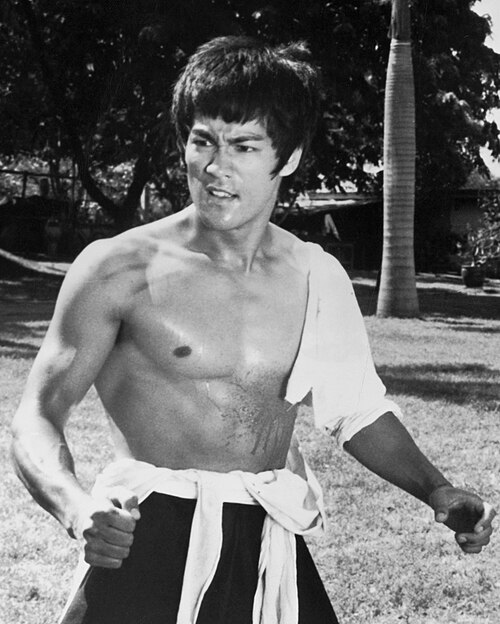
Bruce Lee exemplifies the ISTP personality type, driven by a dominant Introverted Thinking (Ti) function. His entire approach to martial arts was one of deconstruction and logical analysis. He rejected traditional forms not out of disrespect, but because his Ti demanded efficiency and personal efficacy, leading to the creation of Jeet Kune Do with its core principle of ‘using no way as way.’ His decision-making was intensely pragmatic, focused on what worked in a real, physical confrontation, stripping away all that was superfluous. This Ti-Se combination made him a masterful tactician who could read an opponent’s movements and react with devastating, improvised precision.
His auxiliary Extraverted Sensing (Se) is vividly apparent in his incredible physicality, speed, and awareness. He lived intensely in the present moment, training his body to be a perfect instrument of his will. Se fueled his love for direct, sensory experience—whether in combat, dance, or acting. It also contributed to his charismatic screen presence and his ability to perform complex, spontaneous actions. His tertiary Introverted Intuition (Ni) provided the visionary aspect of his personality, allowing him to synthesize his experiences into a broader philosophy of self-actualization and to foresee the global impact of his art.
Interpersonally, Lee displayed the classic ISTP blend of cool reserve and magnetic intensity. His inferior Extraverted Feeling (Fe) manifested in a desire to connect and teach on a grand scale, but often through a lens of personal expression rather than group harmony. He could be fiercely confrontational when his principles were challenged (an Enneagram 8w7 trait), as seen in his criticisms of traditional martial arts institutions. Growth for an ISTP often involves integrating Fe, which Lee did by passionately sharing his philosophy and seeking to inspire others to personal freedom, though always on his own authentic terms.