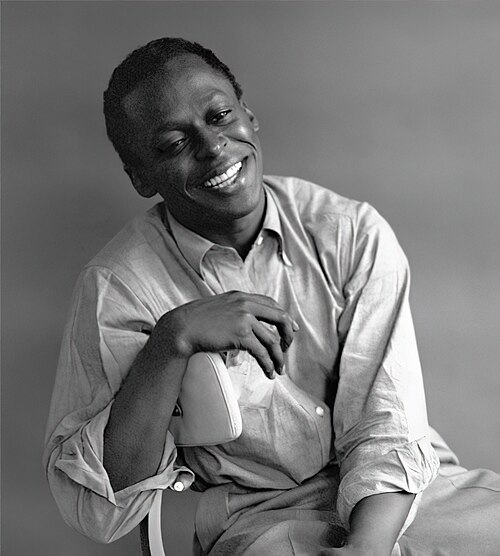
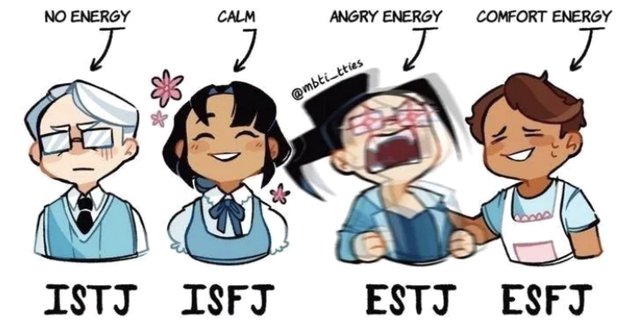
Miles Davis exemplifies the ISTP personality type, driven by a dominant Introverted Thinking (Ti) and auxiliary Extraverted Sensing (Se). His Ti manifested as a relentless, internalized drive to deconstruct and rebuild musical forms according to his own logical standards. He was not interested in theory for its own sake, but in a practical, functional understanding of music that served his creative vision. This made him a brilliant problem-solver who could identify the core essence of a piece and strip away anything he deemed unnecessary or clichéd. His decision-making was intensely personal, pragmatic, and often detached from emotional or social expectations, leading to a famously blunt and sometimes abrasive demeanor.
His auxiliary Extraverted Sensing (Se) was the engine of his innovation. Davis was profoundly attuned to the present moment—the sound of his horn, the energy of his band, and the cultural currents around him. This Se-Ti combination fueled his ‘in-the-moment’ improvisational genius and his ability to physically master his instrument to produce his signature muted, intimate tone. It also drove his aesthetic sensibilities, from his sharp fashion to his fast cars, and his desire for intense, immersive experiences. His creativity was not abstractly planned but emerged from experimentation and reaction to immediate sensory and musical stimuli.
Interpersonally, Davis’s inferior Extraverted Feeling (Fe) and Enneagram 8w7 core created a complex dynamic. He craved deep musical connection and could be fiercely loyal to those he respected, but he often struggled with the harmonious, diplomatic aspects of Fe. He was notoriously demanding, confrontational, and could turn his back on collaborators and audiences alike if he felt they were not meeting his standards or understanding his direction. His stage presence—often playing with his back to the audience—symbolized this focus on internal standards over external validation. Growth areas for an ISTP like Davis involve integrating healthier Fe, which in his later years appeared as a slightly more open, though still guarded, engagement with his public and a mentorship role for younger musicians.
His tertiary Introverted Intuition (Ni) provided the visionary streak that propelled his career through distinct phases. While Se handled the immediate ‘how,’ Ni gave him flashes of the ‘what next’—a compelling, if not always fully articulated, vision of a new musical direction, be it the cool austerity of ‘Kind of Blue’ or the electric fury of ‘Bitches Brew.’ This function allowed him to synthesize his experiences into groundbreaking new concepts, making him not just a master player but a transformative cultural force.