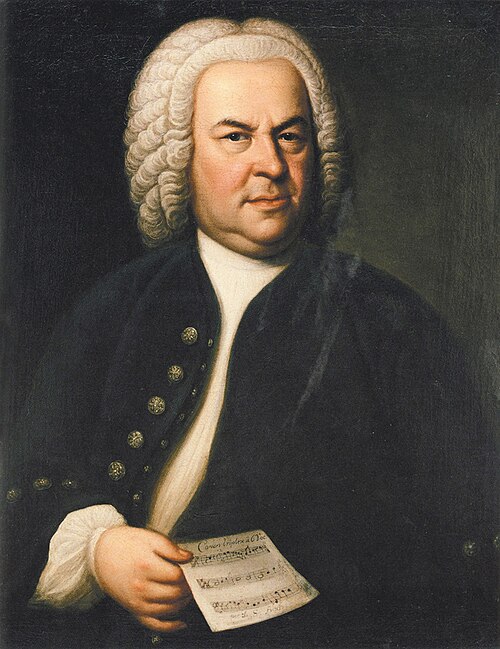
Johann Sebastian Bach’s personality strongly aligns with the ISTJ type. His dominant Introverted Sensing (Si) is evident in his profound respect for tradition, his mastery of established musical forms (like the fugue and chorale), and his meticulous attention to detail in his compositions. He internalized the musical language of his predecessors and built upon it with unparalleled precision. His auxiliary Extraverted Thinking (Te) drove him to create vast, logically structured bodies of work, organize church music with great efficiency, and apply rigorous, almost mathematical, principles to his counterpoint. His output was prolific and systematic, fulfilling his duties to his employers with immense reliability.
Bach’s tertiary Introverted Feeling (Fi) provided the deep, often private, wellspring of faith and emotion that infused his sacred works with profound piety and personal expression. While his music is highly structured, it is never devoid of feeling; his personal devotion was channeled through his craft. His inferior Extraverted Intuition (Ne) can be seen in his occasional, yet brilliant, bursts of innovative harmonic exploration and complex structural ingenuity that pushed the boundaries of Baroque convention, hinting at future musical possibilities, though he always grounded these explorations in established forms.
As an individual, Bach was known for his quiet, serious demeanor, dedication to his large family, and occasional stubbornness in professional disputes (a sign of Te-Fi clashing with external authorities). His growth as an ISTJ involved using his dominant Si not just for preservation, but as a foundation for creating works of timeless genius that synthesized tradition, intellectual rigor, and deep spirituality. His life reflects the ISTJ’s strength in building enduring, masterful systems through disciplined effort and unwavering commitment to their principles and responsibilities.