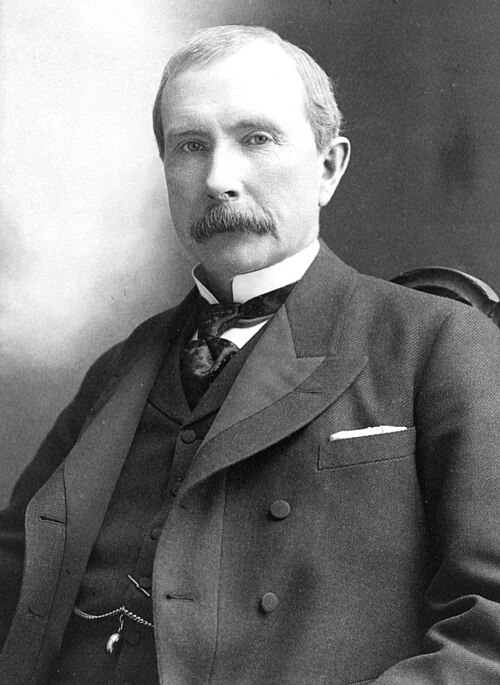
John D. Rockefeller exemplifies the ISTJ personality type, driven by a dominant Introverted Sensing (Si). He relied heavily on past experiences, established facts, and concrete details. His business model was built on meticulous observation of the chaotic early oil industry; he learned from its inefficiencies and created a system based on order, predictability, and control. This Si foundation gave him an almost obsessive focus on thrift, routine, and the preservation of a stable, structured environment, both in business and personal life.
His auxiliary Extraverted Thinking (Te) was the engine of his empire. He applied logical, impersonal efficiency to achieve his goals. Rockefeller was a master organizer and executor, creating complex corporate structures and logistical systems to eliminate waste and competition. His decisions were pragmatic, focused on measurable outcomes like cost reduction and market share. While his Te was formidable, it operated in service of his Si-driven vision for a stable, orderly industry, often leading to methods perceived as cold and calculating by outsiders.
His tertiary Introverted Feeling (Fi) provided an internal moral compass, albeit one often in tension with his Te actions. He saw himself as a righteous man, “chosen by God” to bring order to a wasteful industry, and believed his wealth was a divine trust to be managed responsibly. This fueled his later philanthropic work, which was as systematic and large-scale as his business ventures. His inferior Extraverted Intuition (Ne) manifested as a deep-seated fear of chaos, unpredictability, and potential disaster, which drove his desire for total market control and his later, somewhat paranoid, vigilance. In healthier periods, it allowed him to envision and finance large-scale philanthropic institutions with lasting, transformative potential.