Marcus Aurelius Antoninus Augustus - ISTJ Personality Type

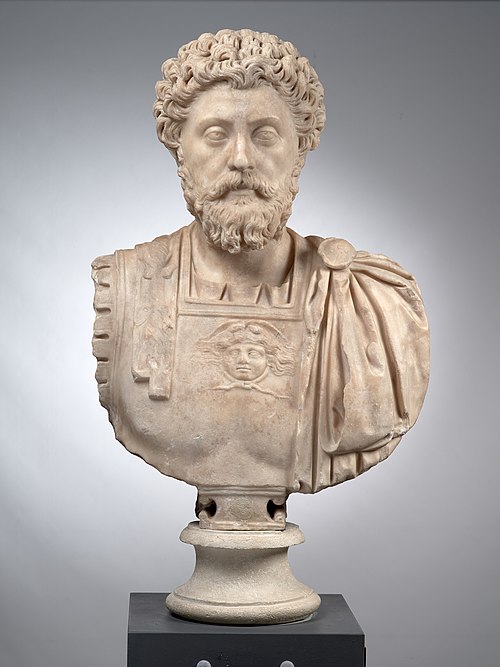
Marcus Aurelius Antoninus Augustus

ISTJ - Logistician

Category

History

Nationality

Roman

Occupation

Roman Emperor, Philosopher

About Marcus Aurelius Antoninus Augustus

Marcus Aurelius was the Roman Emperor from 161 to 180 AD, known as the last of the 'Five Good Emperors'. He is most famous for his philosophical writings, 'Meditations', which outline his Stoic beliefs and inner reflections on duty, virtue, and resilience. His reign was marked by military conflict, plague, and his commitment to philosophical principles of justice and self-discipline.

Personality Profile: ISTJ

Confidence: 85%

Personality Analysis

Marcus Aurelius epitomizes the ISTJ personality type, primarily through his dominant Introverted Sensing (Si). This function is evident in his profound respect for tradition, duty, and the established order of Rome and Stoic philosophy. His ‘Meditations’ are a constant reference to past lessons, mentors, and principles, using them as a stable internal framework to interpret the present. He shows a preference for concrete, tangible reality over abstract speculation, focusing on the immediate duties of an emperor and the practical application of virtue. His auxiliary Extraverted Thinking (Te) drove his methodical and rational approach to governance and military strategy, seeking efficient, logical solutions to the empire’s problems, even when they were personally distasteful, such as prolonged warfare. His interpersonal style was characteristically introverted and reserved, valuing a small circle of trusted advisors and family, yet he maintained a strong sense of justice and fairness (tertiary Introverted Feeling - Fi) that aligned with his internal moral code. His inferior Extraverted Intuition (Ne) appears in his occasional musings on the boundless possibilities of change and the interconnectedness of the universe, but he typically reigned in such speculation to focus on concrete duties. A key growth area for an ISTJ is integrating this Ne, allowing for more adaptability and considering alternative futures beyond rigid duty, which he touched upon but often saw as a source of anxiety to be managed by his Stoic principles.

Supporting Evidence

His personal journal, ‘Meditations’, is a quintessential ISTJ document: it is a practical, repetitive exercise in applying established Stoic principles (Si) to daily challenges through logical self-admonishment (Te). His handling of the Parthian Wars and the Marcomannic Wars demonstrates Te: he methodically attended to military logistics and administration, often from the front lines, despite his preference for philosophy. His deep sense of duty (Si/Te) is shown in his refusal to abandon his imperial responsibilities for a life of contemplation, famously stating ‘what is not good for the swarm is not good for the bee’. His complex relationship with his co-emperor and adopted brother, Lucius Verus, and his problematic son, Commodus, reveals his Fi-driven personal loyalty and disappointment, which he struggled to reconcile with the demands of state (Te). His constant reminders to himself to accept fate and view events from a higher perspective show his attempts to engage his inferior Ne, contemplating vast possibilities to mitigate the stress of his rigidly dutiful life.

Cognitive Function Stack

Confidence: 85%

The cognitive function stack represents how an individual processes information and makes decisions based on Jungian personality type theory.

Auxiliary Function: Te

Extraverted Thinking - Organizing and structuring the external world logically and efficiently.

Dominant Function: Si

Introverted Sensing - Recalling detailed information and maintaining traditions.

Inferior Function: Ne

Extraverted Intuition - Seeing possibilities and connections in the external world.

Tertiary Function: Fi

Introverted Feeling - Making decisions based on internal values and personal ethics.

Enneagram Personality Profile:

Confidence: 85%

1w9

Big Five Personality Traits

Confidence: 85%

The Big Five personality traits represent the five broad dimensions of personality that are commonly used to describe human personality.

Openness 0%
Conscientiousness 0%
Extraversion 0%
Agreeableness 0%
Neuroticism 0%