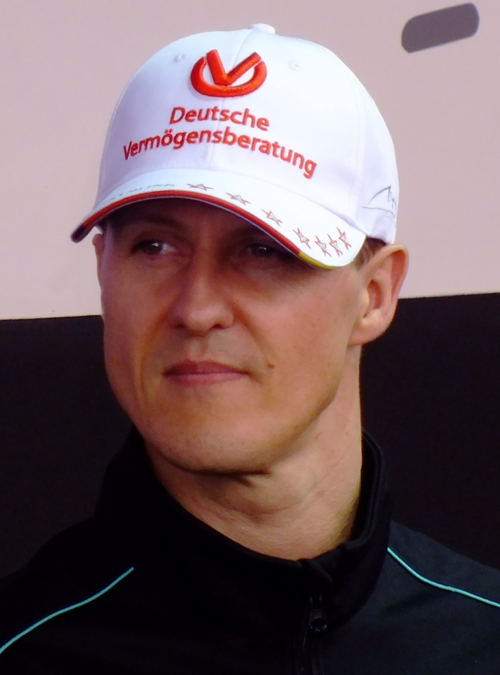
Michael Schumacher’s personality profile strongly aligns with the ISTJ type, characterized by Introverted Sensing (Si) as his dominant function and Extraverted Thinking (Te) as his auxiliary. His driving legacy was built on a foundation of meticulous, detail-oriented preparation. He would spend hours reviewing telemetry data, memorizing track conditions, and perfecting his lines with relentless repetition, a hallmark of high Si. This reliance on proven, concrete data and past experiences provided him with an unparalleled sense of control and predictability in a high-risk environment. His decision-making was governed by Extraverted Thinking, which manifested in his pragmatic, results-oriented, and highly efficient approach. He was a master tactician who viewed the car, the team, and the race itself as a system to be optimized for victory. This logical, sometimes impersonal, focus could override interpersonal considerations, as seen in his controversial on-track maneuvers.
Interpersonally, Schumacher was famously reserved and private off the track, consistent with ISTJ introversion. His loyalty was profound but expressed through action rather than words, particularly towards his inner circle and the Ferrari team he helped rebuild. His tertiary Introverted Feeling (Fi) provided a strong, internal value system centered on excellence, duty, and family, which fueled his intense drive but was rarely displayed publicly. The inferior function, Extraverted Intuition (Ne), represents a potential growth area or point of stress. In his prime, he minimized speculative risks, preferring the security of tested methods. Later in his career, and perhaps in his post-racing life, engaging with broader possibilities and unforeseen circumstances became a more significant challenge.
His Enneagram 3w4 (The Achiever with a Four wing) perfectly complements the ISTJ framework. The core drive for success, recognition, and being the best fueled his Te-driven efficiency. The Four wing added a layer of individualism and a desire to be not just successful but uniquely iconic, which drove his quest to build a legacy and master his craft in an almost artistic way. The low Agreeableness in the Big Five reflects his uncompromising, sometimes combative, pursuit of victory, where winning was a logical objective that superseded camaraderie. His exceptionally low Neuroticism highlights the legendary mental fortitude and ice-cold composure he displayed in high-pressure situations, a critical asset in his profession.