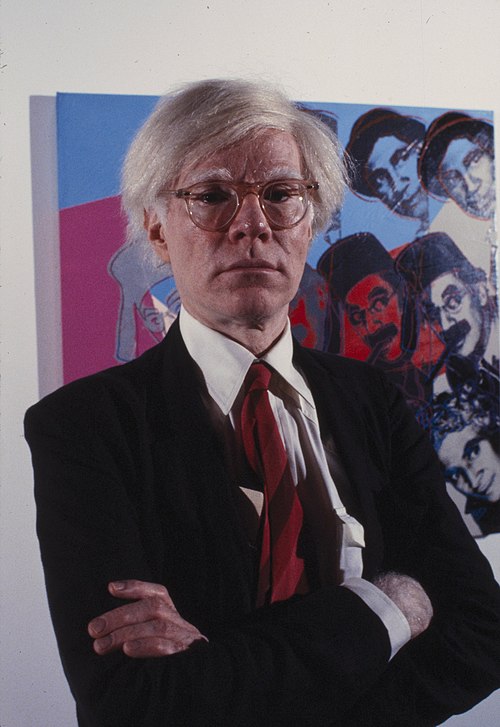
Andy Warhol exemplifies the ISTP type, primarily through his dominant Introverted Thinking (Ti) and auxiliary Extraverted Sensing (Se). His Ti drove his analytical, systems-oriented approach to art. He deconstructed the commercial imagery of American culture with clinical precision, treating the soup can or celebrity face as a data point to be processed and replicated. His decision-making was pragmatic and internally logical, focused on efficiency and the ‘machine’ of production, famously stating, ‘I want to be a machine.’ This Ti dominance led to his famously detached, unemotional public demeanor and his desire to remove the artist’s ‘hand’ from the work.
His auxiliary Se is evident in his intense engagement with the sensory, material world of his time. He was captivated by the glitter, fame, consumer products, and immediate visual stimuli of 1960s New York. The Factory studio was a Se environment—a chaotic, sensory-rich hub of creativity, celebrities, and happenings. Warhol acted as a passive recorder of this environment, using his camera and silkscreen to capture and reproduce what he observed without overt judgment. This Se-Ti combination made him a master of transforming observed reality into conceptual art objects.
His interpersonal dynamics were shaped by his inferior Extraverted Feeling (Fe). He surrounded himself with a ‘court’ of dramatic, emotionally expressive people but remained an enigmatic, quiet observer at the center. He craved social connection and fame (the Fe desire for communal harmony and external validation) but managed it through a Ti-Se lens: he turned people into ‘superstars,’ treating relationships as part of the artistic project. His notorious ambiguity in interviews—’I like everything’—was a defense mechanism against engaging his underdeveloped Fe, avoiding emotional commitments or clear value judgments. His Enneagram 9w8 supports this, showing a desire for peace and merging with his environment (9) while maintaining a subtle, controlling influence (8-wing) over his empire.