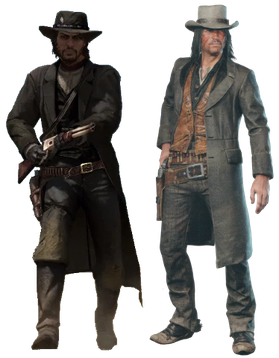
John Marston is a quintessential ISTP. His dominant Introverted Thinking (Ti) drives his pragmatic, analytical approach to the world. He constantly assesses situations, systems, and people with detached logic, figuring out the most efficient way to achieve his goals, whether it’s tracking a target or fixing a fence. He is deeply internal, often seen brooding on his past and present circumstances, trying to make logical sense of them. His decision-making is based on immediate, practical necessity rather than abstract ideals or social expectations. He is the ultimate problem-solver, but the problems are always concrete and in front of him.
His auxiliary Extraverted Sensing (Se) makes him a master of his immediate environment. He is hyper-aware, observant, and possesses exceptional skills in combat, hunting, and survival. He lives in the present moment, reacting quickly and effectively to threats and opportunities. This Se-Ti combination fuels his legendary proficiency with firearms and his ability to improvise solutions on the fly. However, it also contributes to his occasional impulsiveness and his past life of seeking thrills through outlawry.
Interpersonally, John is a classic ISTP with an underdeveloped inferior Extraverted Feeling (Fe). He is stoic, private, and often awkward with emotional expression. His loyalty to his family (Abigail and Jack) is profound but shown through action and gruff protectiveness rather than words. He struggles to connect with others on an emotional level, often using sarcasm or bluntness as a shield. His tertiary Introverted Intuition (Ni) manifests in his grim, fatalistic hunches about how events will unfold, particularly his own likely tragic end. His growth throughout the story involves grappling with this inferior Fe—trying to build a peaceful community, forming genuine (if gruff) friendships, and ultimately sacrificing himself, an act driven by a deep, finally acknowledged feeling for his family’s future.