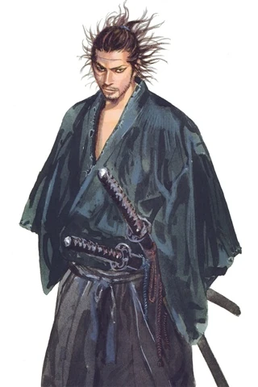
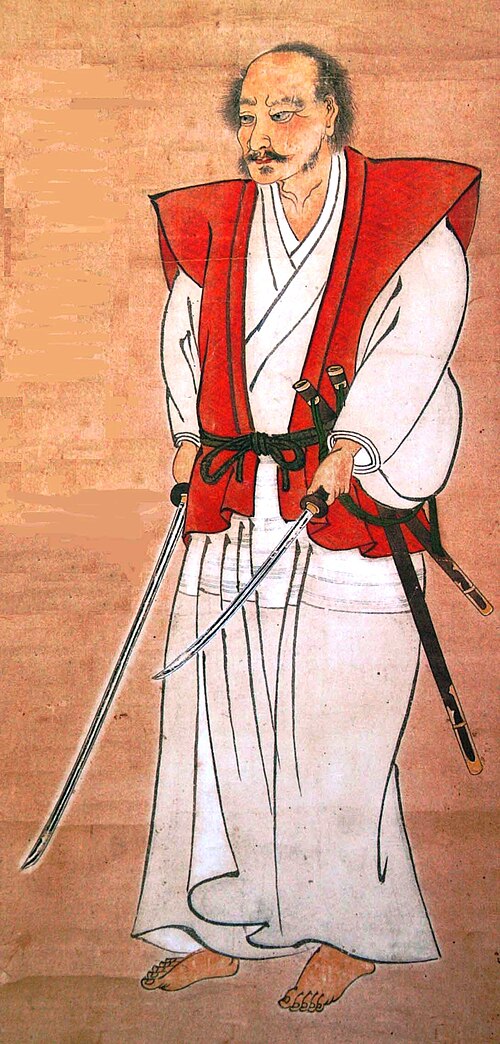
Musashi is a quintessential ISTP, driven by Introverted Thinking (Ti) and Extraverted Sensing (Se). His dominant Ti manifests as a relentless, internal drive to deconstruct and understand the principles of combat, strategy, and later, art and life itself. He builds a personal, logical framework for ‘the way’ that is ruthlessly efficient and free from external dogma. This is supported by his auxiliary Se, which makes him a master of the immediate physical environment. He learns through direct, often brutal, experience, reading opponents’ micro-movements, terrain, and weapon dynamics with preternatural skill. His style is adaptive and improvisational, not pre-planned.
In interpersonal dynamics, Musashi is intensely private and independent, a hallmark of the ISTP. He forms few, if any, deep bonds for much of his journey, seeing others primarily as teachers, opponents, or obstacles within his own logical pursuit of strength. His inferior Extraverted Feeling (Fe) is evident in his early social awkwardness, disregard for conventional etiquette, and struggle to understand or value emotional connection and harmony. His growth, particularly in Vagabond, involves grappling with this inferior function—confronting the emotional and spiritual consequences of his violence and slowly recognizing the value of connection, as seen in his relationships with Matahachi, Otsū, and the villagers of Shishido.
His tertiary Introverted Intuition (Ni) emerges over time, shifting his focus from mere victory in duels to a more abstract pursuit of ‘the invincible sword’ and, ultimately, a philosophical understanding of the universe. This is the core of his later writings. His Enneagram 8w9 complements this: the 8 core gives him a need for autonomy, control, and direct confrontation, while the 9 wing adds a desire for inner peace and a stoic, less reactive demeanor as he matures. His journey is one of integrating his formidable Se/Ti mastery with the deeper insights of Ni and the connective, human awareness of Fe.