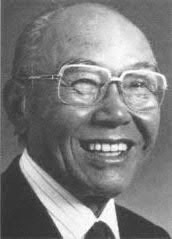
Soichiro Honda exemplifies the ISTP personality type, driven by Introverted Thinking (Ti) and Extraverted Sensing (Se). His dominant Ti fueled his analytical, internal framework for understanding how mechanical systems work. He was less interested in abstract business theory and more in the logical, efficient functioning of engines and machinery. This made him a masterful, independent problem-solver who trusted his own reasoning above established dogma. His decision-making was intensely pragmatic, focused on what worked in the immediate, physical world.
His auxiliary Se was vividly expressed in his hands-on, tactile approach to engineering. He was constantly in the workshop, taking things apart, testing prototypes, and learning through direct experience. This function gave him a keen awareness of real-world mechanics, an appetite for speed and risk (both in racing and business), and an adaptive, ‘in-the-moment’ style of innovation. He thrived on new sensory challenges and practical results.
Interpersonally, Honda’s inferior Extraverted Feeling (Fe) manifested as a disregard for social conventions and corporate formalities. He was famously blunt, impatient with bureaucracy, and valued competence over titles. However, his tertiary Introverted Intuition (Ni) provided flashes of visionary foresight, allowing him to grasp future trends in personal mobility. His growth area involved developing the Fe necessary to build a large, cohesive corporate culture, a task he eventually delegated to his more people-oriented partner, Takeo Fujisawa.
As an Enneagram 7w8, his core drive for new experiences and freedom (7) was combined with the assertive, confrontational energy of the 8-wing. This made him an optimistic adventurer who fiercely protected his independence and challenged any obstacle head-on. He saw problems as exciting puzzles and business setbacks as temporary detours on a thrilling journey of discovery.